Episode 16: Lebo
Lebo plays an acoustic guitar with a magnetic pickup in it, through an amp, in a rock band – and the body behind the bridge keeps hearing the whole room.
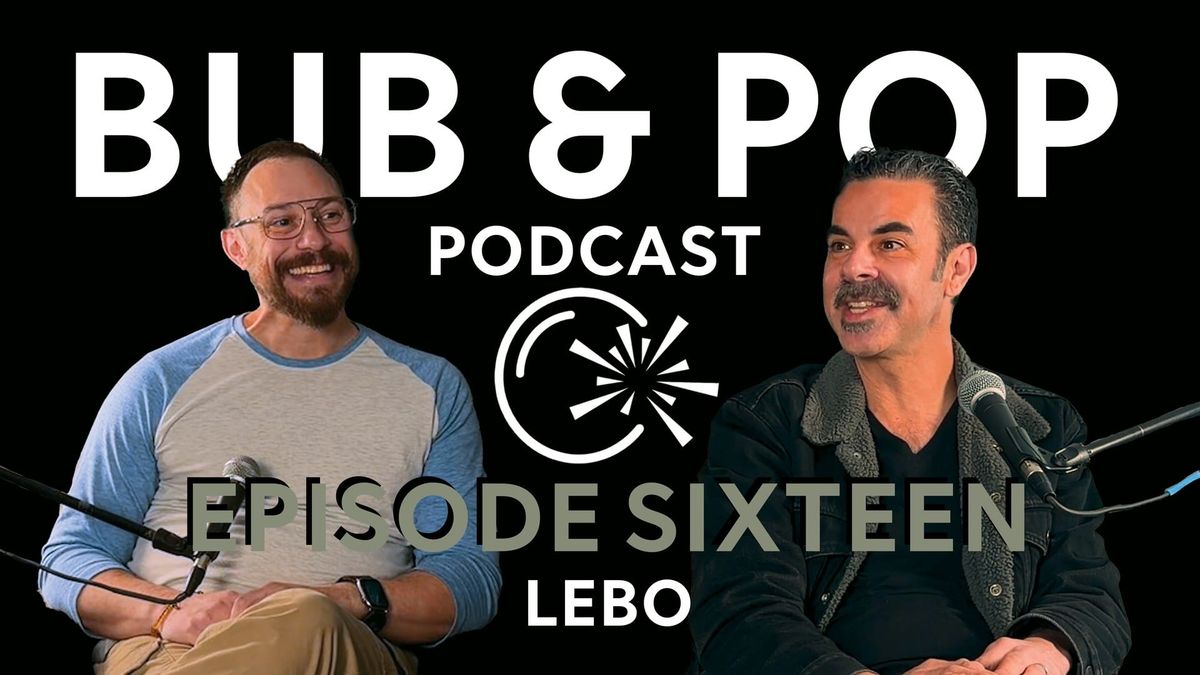
Bub & Pop | Episode 16: Lebo (recorded May 9, 2026)
Lebo plays an acoustic guitar with a magnetic pickup dropped into it, through an amp, in a rock band. If you know anything about guitar electronics that sentence should bother you a little. It works because the body behind the bridge stays microphonic – the guitar is hearing the whole room and feeding it back through the strings.
He can prove it. On an ALO cover of “I Shall Be Released” cut with Jack Johnson, there’s an ethereal wash under the piano intro that nobody played. Lebo’s hands weren’t even on the instrument. It was the piano, in E against a take in B, activating his strings from across the room.
He met Zach Gill and Steve Adams in seventh grade in Saratoga, California, back when the orchards were still turning into Apple buildings. The band they started at twelve is ALO, and it’s still going. Their first gig was a talent show that turned out to be a school play, and they only got to play because the production was short on boys.
The back half goes somewhere else entirely. Lebo describes a Venn diagram he lives by – discipline on one side, all the prep and the set lists and the hours at home with guitars lying around; surrender on the other, where you walk over the threshold at 7:59:59 and let all of it go. Either half alone, he says, is necessary but not sufficient. The overlap is flow. From there we got to what Phil told him backstage at Terrapin Crossroads – that the point isn’t to put something into the music, it’s to let the music pull something out of you – and to why Edward Van Halen’s beat-up, drilled, tape-marked guitar looked better to a kid flipping through Guitar Player than anything clean on the shelf.
Also in here: St. Vincent’s favorite guitar solo, an ALO tune that only came out in Japan, and the solo on “Plastic Bubble” that Lebo begged the band to let him fix and is now glad they didn’t.
An audio-first version of this podcast is available here.
Dan “Lebo” Lebowitz | Website | Instagram | X | Facebook | YouTube
Also mentioned: ALO | Instagram | Spotify
Bub & Pop | Website | YouTube | Instagram | TikTok | Facebook | X | Threads | LinkedIn | Audio-first | Discord
Host: Matt Hoffman | Producer: Tedd Kanakaris | Location: Rising Sun Presents
TRANSCRIPT (lightly QC’ed)
Matt Hoffman [0:00]
Hi, I'm Matt Hoffman, and this is the Bub & Pop Podcast, where we talk about music, careers in music, life, the universe, and everything. ["The Bub & Pop Podcast Theme Song."] Our guest this week on episode 16 is Lebo, guitarist in ALO, formerly Animal Liberation Orchestra, as well as his own ongoing project with a rotating cast of characters that he calls Lebo and Friends. Lebo's a great guitar player, both technically as well as mechanically, in the sense that he builds his own instruments and tinkers with the electronics to dial them in to get a sound that is uniquely him. That's one of many things we talk about on this week's episode, which at times dips more into philosophy than even music, which is totally up my alley. Lebo's a great hang. This was our first time talking and certainly not our last. And I hope you enjoy this episode. Like, what line of work were your folks in?
Lebo [1:13]
So, uh, my mom is, uh, well, she's retired now, but she was a teacher. Uh, she taught special ed. Um, and, uh, my dad, he's a radiologist. And he, uh, he and I, in a weird way, like, I'm not a weird way. We're all super influenced by our parents, but, uh, he, then I come along and become a musician. He's like, but in a weird way, I feel like there's a, there is a commonality with it. Um, I will say my dad, uh, it's like, he's, he's like, he like loves his work, just loves doing it. And, um, and that was a big lesson in my house growing up, was like, make sure, make sure you love what you're gonna spend your time doing, because that's your life. You know, your life isn't the things you get from it. You know, after the fact, he's like, I mean, sure, that's part of it, but like, your life is that, how, that's your day, that's five days a week, 10, eight, 10 hours a day, whatever it is. So that was the, the, the, the sort of message in the house was like, was like, you should work hard, but make sure you do it at something you love and figure that out. And then, so, um, yeah, that was, that was, they were encouraging in that way. And I think because I got into it and kind of jumped in and, you know, kind of got stuff going on by high school. So, they were, they were like, okay, you want to go major in music, cool, go do it.
Matt Hoffman [2:42]
And am I right that you studied, was it ethnomusicology?
Lebo [2:46]
Yeah, studying ethnomusicology, exactly, which, um, which is interesting. So, okay, so, so there's one thing I should bring up, before that, is that my, uh, so, so, uh, I have an older brother, uh, and two years older than me. And so, as often as the case with the younger brothers, you get real influenced by your older brother. He was just super into music. So, um, and his friends were super into music. So, I got kind of, you know, jazzed on that, looking up to them, you know? Um, so, basically, uh, he did a lot of music, but then he veered away and he got more into writing, like, like fiction and things. Oh, wow. Um, but, but I got the music bug. And then I met, uh, in middle school, basically in seventh grade, because in our town, I'm from a town called Saratoga, California. It's the inland side of the hill from Santa Cruz. So, I kind of, I grew up there, which, and another side to that is it's like tech land now. When I was growing up, I moved there in the 80s, you know, as a little kid, and it was still just like orchards down there. And there was this thing, Apple computers, that kept, like, getting new buildings and spreading down the ends of all of it. Like, to the point where by the end of high school, it was like, it was like 10 blocks of just Apple buildings. Yeah, totally. But yeah, so for our background, it was still a little bit of a farming town a little bit. I mean, it was transitioning big time, but it still had a lot of that vibe. And so, I met in seventh grade, Zach, uh, Gill and Steve Adams, who are my bandmates in ALO. Um, the three of us met and a drummer, and we decided we wanted to start a band. Uh, so, and I'm still, three of the four of us are still going strong. So we basically started our thing together, like 12, 13 years old.
Matt Hoffman [4:30]
I have to say, so I first, I think it was Fly Between Falls was the first time I became aware of you guys. And there was a tune that I think was just on the Japanese version, the American one. It might have been one you wrote, Possibly Drown.
Lebo [4:45]
I didn't write that. I mean, Zach wrote that, and then we worked on a bunch of the music together.
Matt Hoffman [4:49]
I love the tune. The lead is just great.
Lebo [4:51]
Yeah, no, totally. That one's classic. So that, uh, as far as the history goes, uh, you know, I won't do the long version, because it could, like, I've been with those guys for some freaking long. Yeah. Um, but we, uh, we went through high school. You know, that was middle school. We did our first gig. It's a funny little story. It was a talent show. We went to the audition. And, uh, found out it wasn't a talent show. It was, yeah, so, you know, we all took, yeah, school play. So it turned out to be a school play, but then, uh, they felt, uh, like we brought our amps there. And they're like, well, you can play a song first. So they're like, cool. And then we played our song, and it went pretty good. And they were like, well, if we're short on guys, if you agree to be in the play, we'll let you play at the intermission. So that was our first gig. And we got the bug. The gig went great. Like, I, sometimes I wonder, like, oh, what if that first gig hadn't gone well? Like, but, like, it just went great. And honestly, being in the play was great because we'd already been on stage for an hour by the time we went to play. So, like, the jitters were gone, and it was like, let's play some music. So...
Matt Hoffman [5:58]
Tedd's son is, is he 13? Yeah. He's 11. Yeah, actor, musical theater. Yeah, okay. You know, the acting thing was just sort of a means to an end, I guess.
Lebo [6:07]
For that, for me, it was. Again, I was around a lot of theater. My parents are really into theater, and I'm really into musicals, actually. I grew up with a lot of musical theater.
Matt Hoffman [6:16]
Okay. What are some that stay with you?
Lebo [6:19]
I mean, the cassettes in the car were, there was a lot of, like, everything from, like, you know, at that time, the more modern stuff, like Cats and The Miserable and all that. But also, like, Anything Goes and Camelot and all this stuff, like, all of it, you know? They were big into it. And interestingly, you know, a lot of the, like, in jazz, a lot of the, like, standards, you know, they're sort of that, it's the same type of harmony. Yeah, they're all pop tunes. So, yeah, exactly. So, I, even though I don't listen to a lot of musical theater now, that sort of tonality sense, I think it was really great to hear all that. So, my road trips would have been, like, a mixture of that and then, like, Jackson Browne and the Eagles and stuff like that. Nice. But yeah, anyhow, just to cap that last little bit off. So, we did, it went great. We went through high school. We started writing music in high school. And then when it was time to go away to school, because you asked about ethnomusicology, we just applied to schools and UC Santa Barbara was, like, the one school we all got into. And really, we just wanted to keep our band going and we're like, okay, we'll go to school and do that thing. So, I didn't even, like, look at it before. It's like, oh, that's where we all got into. Let's go there. So, we went, I think my first time seeing it was at orientation. I knew I wanted to be a music major. You know, I had to submit stuff to audition for that. And I got in and everything. And I was, my initial thought was to study guitar, honestly. But I love more classical music, you know. I really love it. The department is very, at least guitar department at that time, this would have been in the 90s, was very focused in that realm. And I pretty quickly learned, I was like, if I'm gonna study, you know, classical guitar here, I gotta, like, go all in on that. And I was all in on my band. You know, I was like, I like that, I'll work on that. But I wanna work on my rock. You know, that was like what was exciting me. And at the time, I didn't know this, but I think later in life, I realized, like, you really gotta follow your heart on that kind of stuff. You can't do the thing, you know, you're supposed to do. You need to do the thing you need to do.
Matt Hoffman [8:36]
I think so. Yeah. One of the frameworks I use now is like, what am I gonna regret more than 30 years having not done it? You know, that doesn't always kind of lead the way, but a lot of times, you know, it's kind of North Star.
Lebo [8:50]
Totally. And at UCSB once, so once I kind of realized, I started being like, okay, I'm in the music major, I can still pivot within years. So I just started taking lots of different things and a lot of composition, which I loved. And then also I just was taking all, you know, whatever the sort of offerings were there. I liked all this stuff, so I was just kind of eating up. And then suddenly after a little over a year, I suddenly was like, oh, I should like, I gotta kind of like declare what I'm doing here. And I just looked and I was like, oh, I have all this ethnomusicology stuff because I'm like, it's kind of where my interests keep falling. So I was like, cool, I'll just, again, I'm psyched on my band and I can handle school. So, and this is all really interesting shit. And actually every single jazz-oriented class fell under the ethnomusicology department. Because it was like, their focus was concert art music, you know, which a lot of people know is classical music, right? So anything outside of that was just like in ethnomusicology. So I think that's kind of partly why, like there's, you know, stuff on Afro-Cuban music and culture and I would take that, you know, on Hawaiian, you know, and Puerto Rican, like all this stuff. And it's like, so suddenly that's where I landed. And then, but we were always keeping our band going, we finished school and then we, you know, from there, it's like, just became a musician. And I haven't looked back, honestly, like, it's been all great.
Matt Hoffman [10:09]
Well, it's also kind of interesting, like, so there's one person in this world, two people, who are not professional musicians, who like knew what they wanted to do as kids, went to school to study it, started doing it and continue doing it. One is a meteorologist. The other is my cousin who studied music, but he's now a guitar tech. I think he's currently in Asia with Post Malone. Oh, cool. Right on, yeah.
Lebo [10:34]
Yeah.
Matt Hoffman [10:35]
But like for you, I mean, you went to college, you know what you wanted to do, but that was kind of adjacent to the college piece. I went to college like any kid. I mean, my parents didn't graduate college, so it was really important for them.
Lebo [10:48]
Yeah, that's a generational thing often. Exactly. That's my parents' situation. Okay. Because they were like that.
Matt Hoffman [10:54]
Yeah. Now, what was your kind of study of music like in high school, I guess?
Lebo [10:59]
Well, you know, I'm fascinated by this in a way, because it's like, there was so much less available. And I know like at that time, the people who were my age would have been like, oh, there's so much more available now than there was when we were kids. But that's just the nature of how it goes. But a big part of it back then for me was like finding people that knew the secrets. Because they're like, I would get the music books, but it wasn't that helpful usually, because it's just like, you know, the way at least this would have been...
Matt Hoffman [11:39]
Like Al Leonard books and stuff.
Lebo [11:40]
Yeah, I mean, it was cool for learning songs, but it's not really like the thing, you know? And so for me, in our town, so I was in that in Cerro, there's a small town, but there happened to be this guitar shop, it was called Torres Guitars. And they did, they sold guitars, where I got my first guitar. It was small and a lot of their business was as a repair shop. And then eventually they started making really great custom guitars too. But back when I was a kid, they were more in that kind of repair shop zone. So I would go down there, because like after school, I could just, it was five minutes from my school. And I was kind of like, you know, the annoying kid who just like hung out at the shop. Like, because I was like, I would see all these musicians coming and going to get their guitars repaired. And they were like the musicians in the South Bay, you know? Because it was kind of one of the main shops for that. So it was cool. I would just hang and whenever anyone picks up a guitar from a shop, they go plug it into an amp to like check it out and be like, oh, you know, the action's good or I need to adjust this. And I would just kind of like, they'd do something cool. And I would just be like, show me that thing. You know, like show me that thing, you know, that they would usually like, you know, they would show me something cool. And then I would go spend the next couple of days just trying to like digest that. What does this mean? And you know, and I had a teacher too, who was really great too. He was, I didn't last that too long with my first one, because, you know, he's more just like teaching me songs and eventually I could kind of do that on my own. But I had a few really great teachers too, even after that. But in some ways, like so much of what you learn is just by doing and so having that place to go to was cool. Yeah, absolutely. So eventually I learned how to do some stuff and I, after college actually, while we were getting our band going, I apprenticed with that same luthier. And then I ran all the repairs at Haight Ashbury Music Center for like a year and then touring started and I was like, this is what I was wanting. So then I, so that was the one little thing in the middle I did for a job while I was like getting it together.
Matt Hoffman [13:49]
Well, so at what point then did you sort of doctor up your first guitar?
Lebo [13:53]
Oh yeah, that's a thing for me. Yeah, like, okay. So I feel like for me, this is how I've kind of come to think of it. Like I'm a musician and that's like my life's work is like I'm all in on this quest of music, you know, the searching and the like, it never ends, right? Like I'm sure every musician you talked about, it's like the more you get, the more you realize is out there, right?
Matt Hoffman [14:20]
My friend Mitch Beer calls it the infinite game.
Lebo [14:22]
Yeah, it's an infinite game and it's like, and I always dig the like the idea too of, it's almost like a renewable resource. I think where most things in life, if you use them up, like if you drink that cup of water, it's gone. But I feel like creativity and music, the more you use it and give it, the more full it gets. Do you know what I mean? And if you don't use it, you go to use it and it's like empty. Do you know what I mean? It's like a muscle that just like the more you do it, the more it is and the more there. So yeah, so what was the question?
Matt Hoffman [14:59]
Oh, well, so, but I guess for you, well, so for anybody, there's like the musician side and the instrumentalist side. Oh, you asked about the guitar. Exactly.
Lebo [15:10]
Right, so, okay, so that, so that, the thing for me with that is I've always, this is what I was getting at. That's my life's work, that music thing. But my hobby, I have a hobby and that is like tweaking around with guitars and gear and building pedals and shit like that. And that's, and I used to just see it all as one thing. It was just all music. But then at a certain point, as music got very busy for me, you know, with touring and playing with other people and all that kind, I realized, oh, this is, that's the thing that is my thing that I most love. And so I always prioritize that. And then once I deemed the sort of thing a hobby, it was actually very liberating because I didn't feel, I was like, oh no, that comes after that. Great, it's easy decision process. Cause it, cause I'm kind of the kind of guy, like I just get excited about stuff and then I want to do those things. So I have to like figure out how to prioritize. I can relate. Excitement, yeah, right? No, totally a lot of people, right? But so that, I just was always, I've always been that way from the very beginning. Like when I first got my guitar, you know, I think one of the first things I did was like, oh, what's this screw do, you know? Like I'd be working, playing, working on my playing and all that stuff. But I'm all, I like, I like, I like to know how things work. Yeah. Actually, I would just maybe say that. I like to know how things work. So, and a lot of the times the way you feel that is by taking it apart. So, so then I was, but I was always an electric guitar player. I didn't even own an acoustic guitar for all my childhood.
Matt Hoffman [16:41]
What kind of electric guitar?
Lebo [16:43]
It was like a knockoff Les Paul's what I started on. Then I got that shop there when I was like, basically, cause like I said, we were like, we're gonna, we're gonna form this band. Yeah. I need a guitar, you know? So I didn't know anything. And they're like, we got this used guitar here. You know? So I was like, cool, that sounds great. And then, and then after that, my uncle's Tele actually was the first guitar I remember. Cause I'd go to my grandma's house. This is when I was a very little kid and it was just sitting in the closet and I would be like, I would just take it out. You know what to do. I would just kind of like, like stare at it. You know? But so that was a big, and I have that guitar now. He gave me that.
Matt Hoffman [17:21]
Oh, that's awesome. So what year was the Tele?
Lebo [17:23]
1974. Same year as me. We're the same age. Oh, wild. But I should cut to the chase with that of, of the things I just like, we were, this was a weird time where when we first moved to San Francisco after finishing in Santa Barbara, we were kind of between, we'd split with our drummer. And we've had a bunch of drummers over the years, but Zach, Steve and I have all, the three of us have always stayed together. And we were like, well, we were just like playing a bunch of acoustic music and we were just got to the Bay. And like I said, I was, I was apprenticing with that luthier. And we were just trying to figure out what it is we were going to do next. You know, we were in this new place. And so we're doing this kind of acoustic gig. And then sure enough, like we'd be playing these bars and it would get rowdy. So my guitar, I just, I got tired of running the acoustic through the PA and being at the whim of a sound engineer for monitors, especially the gigs we were doing. These were not fancy sound systems. So I would, I just started bringing my amp, you know, and then plugging in. And then I didn't like the pickup in it because it was like the under the saddle. So I put in a sunrise pickup, which is a magnetic pickup, you know, and then I just was like, oh, this is cool. This feels a little more at home. And then I was just like using the amp. And then eventually we added a drummer to it. And then the whole thing like turned back into a rock band, but I kind of like found that guitar. And I was like, just digging it. I was like, this thing's cool. And then from there, I just tweaked with lots of different pickups and different things. And I do a lot to every fretted. I carve a new nut when I need to, whatever needs to happen, you know, like I'm not afraid to drill holes and go crazy. But eventually it got to this thing where I was doing this other gig and it was, oh, back to a traditional day. So I grabbed my electric guitar and was doing, it was a short tour I did with someone. This is all when I'm like, you know, 22, 23, something like that. And I did the gig and I was like, cool. This is what the gig calls for. And then I was on the road and I had an acoustic. I had my acoustic for just playing on the bus. RB, you know. And I broke a string and it was the last song of the encore and I didn't have time to change strings. So I just grabbed the acoustic and plugged it in. And it was like, oh yeah, this is what I love. This is what I've been doing and I didn't do on this gig. And then honestly, I was just hooked at that point. I was like, I just want to pursue this because what I'm going for is very much an electric vibe, but it's not a Strat, it's not Telly, it's not Les Paul. It's just like its own version of that. And I love it.
Matt Hoffman [19:56]
It's neat too, because like, you know, as I think about it, an acoustic guitar is just kind of like a microphone sort of, where an electric guitar has more to do with magnetism. You're kind of like blending.
Lebo [20:08]
You're blending very much so. Because the guitar itself is very microphonic. You know, like behind the bridge, that whole area, it's just picking up the band. Yeah. But then I'm using magnetic pickups. So it's picking up the strings a lot. Like you say, it's doing it like an electric guitar, but there's all this other information. This is a funny thing. If you can find it, it's on the streaming services. It's a version of I Shall Be Released that we recorded with Jack Johnson. Okay. For some compilation. It was, I think, a band compilation. This was like a long time ago. Sure. It was like 15 years ago probably or something. But it's really cool. If you listen to the intro of the tune, so this is the assignment for people who watch this, is find it. It's on Spotify. And if you listen to the intro, there's a piano intro. But you hear this weird ethereal shit happening in the background. And what it was was, so my amp was in the other room, right? But the piano intro, I was just sitting there with my guitar and I didn't have my hands over it. And I was pretty close to the piano when we were tracking it. And so we did it. We did the take, you know, and it was great. And then when we went back in to, you know, later listen back to it, we were like hearing this thing on the intro. Like, what is that? And then we like, the piano sounds trippy. It's got this weird ethereal thing. And then we like went and soloed out the guitar and it was like the piano going into the guitar because it was an E we did in the key B. And so it was just like activating all this shit. And that's an extreme version because I had my hands off it. But nonetheless, my guitar is very much taking in the band. And that comes out through the amp too. In a weird way. I mean, it's maybe, you know, you don't hear it, but what I think it is, is that the strings hear it. So it affects what's going on in it. You know what I mean?
Matt Hoffman [22:05]
Well, and it's very like kind of natural, organic, you know, I want to say human. Right. In a way that you don't get with, you know, and I'm with Rick Beato when it comes to this stuff, like snapping everything to the, you know, the click. And it's just like, no.
Lebo [22:21]
The imperfection is where the human part lies. But it's a conundrum because we're all like searching for perfection all the time. But it's sort of like that search then where you, a lot of my favorite stuff is where, yeah, it's sort of the space in between that. You know what I mean? Like if the Rolling Stones could have been as informed as they could be today and could have just been a blues band to just sound like fucking Muddy Waters. Yeah. I think that's all they want to do, but they couldn't. And that's why they sound like them. And that's why it's fucking great.
Matt Hoffman [22:55]
But it wasn't until they put out the blues record within the last like 10 years. And finally there are these like old grizzled, it sounds amazing.
Lebo [23:03]
Yeah, it's almost like the gaps are what make you special. And then finding that's cool. Like I've always been drawn to, I think that my community around growing up to the bands we were hanging with were definitely like, there was a high value on trying to, how do I say, like not just trying to like recreate something like, but the idea of like trying to do something that's uniquely you. And honestly, I feel like that's part of what's tied up in my whole guitar thing. It like keeps me in a certain zone. That's less common. And I mean, first of all, you gotta have a good sound and you gotta love it. And I have that with that. But then the real bonus to me is it's like, oh, it kind of like, it keeps me in my sort of zone that's different. Sure. You know what I mean? And I don't mean boxes me in. Like I can do so much with that guitar. That guitar can, it's amazing. It can do anything. You know what I mean? So it's like, but it's just a different lens. It's a different lens.
Matt Hoffman [24:05]
It's also, I mean, it is kind of neat how, you know, in my mind, in the best situations, the guitar and the player almost become one. And I think about like, I mean, and there are different drivers for people to make their own instruments. Like Edward Van Halen was poor. So like he had to. Totally. Brian May is a rocket scientist. So that was why he, it's like.
Lebo [24:27]
Totally. I grew up on like that Van Halen music too. Me too. I feel like somewhere deep inside, like how I said, I like to find out how things work. I feel a kinship with him. Of course I never met him or anything, but I do feel a kinship in that. Like, I know he was that way too of just like, let's just take this thing apart and see what happens. And we might fucking break it and ruin it. But like, let's try it. Because we'll never know if we can like make something cooler. Yeah, exactly. Like all his whole way of doing that with guitars and just like making his own stuff. I was, I think I really admired that as a kid. I think that was something I noticed. Like when I, you know, the posters in Guitar Player Magazine. His stood out because I was like, his guitar is like way different. Everyone knows they got these Les Pauls and these Strats or at that time these Ibanez, whatever. But I was always like, his is like, how come that one said, oh God, it's got all those weird holes in it and gashes in it and tape marks. And when I was always like, that's cool. That's interesting. To me, that's way more interesting than just some clean thing off the shelf.
Matt Hoffman [25:29]
Oh, for sure. Well, it's also, it's been kind of cool seeing over the last year, like a lot of Jerry's guitars have been kind of making the rounds. I saw some videos this week of Al Di Meola. Yeah, I saw that too.
Lebo [25:39]
It sounded amazing. Unbelievable. That was actually one of the funnest ones to see of that because I know his sound real well. And it was interesting. It really, that garciatone was really coming through that instrument. But again, his playing was ever present in it.
Matt Hoffman [25:56]
Yeah, and in my head, there's the, he's always an acoustic guitarist in my mind. Oh, because of that. With the John McLaughlin. Yeah, that Friday night. Yeah, exactly, which is classic. I feel like with some musicians, it's always just about like, say, getting the songs and kind of the covers and like the planned stuff to sound better. And for other folks at a far end of the spectrum, it's like, I'm gonna walk in and have no idea what's gonna happen and just be totally free and figure it out. You know, you seem to have kind of evolved more and more towards that improvisation end of the spectrum. When did that start to first kind of click for you?
Lebo [26:34]
Yeah, so this is a neat question because I have a strong concept actually that I kind of live by around all this. And it's sort of, I think the easiest way to explain it is like a Venn diagram, right? And I'm like, on one side is discipline. And that's all the work, you know, which, and I say work, a lot of times it has like a negative connotation again, like I'm completely happy to work on music. It's a joyful thing, but it's work nonetheless. It's hard work, you know, like every day I do music. I have guitar string about my house. I'm picking them up constantly. Like I'm always working on it. That's the discipline. And if there's a show to be had, I'm very into getting under the hood on the set list and getting into nuance and really, I love this. I love the nuance of it all, so discipline. And then the other side of the Venn diagram would be surrender, which is where you just let go and be. And what I find is that either of the two on their own kind of suck, you know what I mean? Like if you're, I know musicians who are very disciplined, they can do all the things perfectly, you know, but they never leave discipline and they're not very fun to be around because everything's always supposed to be a certain way. You know what I mean? And I know musicians who are amazing, intuitive musicians who are fully surrendered all the time. And they do beautiful things too. Like they have all this cool intuition, but they're so surrendered that they've never done the prep. And you kind of like, if I'm in a music director role, for example, and I'm playing with those people, I know, okay, I got to pick certain material because then they're not going to do the homework. Where I love to live is when you put that Venn diagram together, there's a new zone and it's just called flow. And when you get to me, that's the whole thing is it's like, I love working on it, I prepare, prepare, prepare. And then if the show starts at eight at 759, in 59 seconds as I walk over the threshold onto the stage, I surrender. And if I do my good prep and then I successfully surrender, you just get in this flow zone in the middle that's so wonderful because you have all this stuff to fall back on, all this stuff you've done, maybe planned, whatever, you know the material, all that kind of stuff. But then you can just let all that go and invariably all this cool shit happens that over on the discipline side, you never would have imagined or could have done. You know, if you just were always like, oh no, it's got to go there. It was like, no, no, no, now I'm just listening. I'm just listening and being and my playing's following that. And so I hope that answers the improvisatory state. It really is to me, mostly a state of listening. And then kind of like when you're talking, you're just, you know, you don't prepare all your words. You just, if you're in a good zone and you're listening, you'll have something to say. It's about presence too.
Matt Hoffman [29:40]
Like, you know, this is something I think about just as an interviewer and as a writer and like, look, if we started talking about Teenage Mutant Ninja Turtles and that's where the conversation went. Yeah, just let it go.
Lebo [29:52]
So yeah, because that's the thing. It's like you can have your plan. And I think it's a real metaphor of life. You know, playing at Terrapin Crossroads a lot with Phil, he was, you know, obviously a real master of improvising and specifically the state of improvising. And I remember one thing, I've mentioned this to other people before, but like we had such great like backstage talks over there. Terrapin, it was always a good hang and we get to talk a lot of the music concept. And like one of my favorite things, probably like my favorite thing actually kind of, he said, at least the one that stands out the most was he was talking about the music and he was like, with this music, we don't try to put anything into it. We just try to let it pull something out of us. And it's cool. It's so profound because you're like, you're gonna do something. You're here, you're gonna do something, but what are you gonna do and why are you gonna do it? And it couldn't be a more different reason, you know, that I'm gonna put something into is that disciplines. I read, oh, I got my fancy thing. I'm gonna really show these people tonight. When we get to that tune and we go, I'm gonna put this. And it's just like, no, like it never works. You know, like, whereas if you just, again, if you did your work and then you let go and you're out there, then the music will pull something out of you and that's so much more authentic and so much more truer to the moment and so much more truer to the people you're on stage with. So, I love it. That kind of short statement he said really goes hand in hand with that sort of, you know, and I try to live by it, not just in music, in life.
Matt Hoffman [31:32]
How does that show up elsewhere in your life?
Lebo [31:34]
Everything, you know, like if I'm just going out somewhere, I don't wanna have like some preconceived notion of what I'm gonna talk to people about, for example, you know, but like I'm excited about things. So I'm getting formed, you know.
Matt Hoffman [31:46]
Well, and there's a lot of research just on the kind of psychology, social science side about that flow state, you know. Tell me about it. Oh, well, so there's this Hungarian psychologist, he since passed away. I'll send his info later, a guy named Mihaly Csikszentmihalyi, I think, and he describes the flow state of really being on the border of kind of like what you're capable of and sort of pushing, getting feedback in the moment so you can adjust. And it's essentially just sort of getting lost in, really getting lost in the moment. And I think like you're saying, when you really know your shit and kind of come with the right head space,
Lebo [32:31]
they connect. There's a guy at UCSF who I've never met. I'd love to meet him someday. He's a neuroscientist and he's up in...
Matt Hoffman [32:41]
Is this Huberman? No.
Lebo [32:43]
Okay. His name is Lim, I think is his last name. He's a neuroscientist. He's, I think, worked big on like the cochlear implants and that kind of stuff for people to be able to hear, you know, like, but he's done these studies because UCSF is a research place. So he loves music and he's done these studies on improvisers and what's going on. And he put them into MRI to basically scan their brains.
Matt Hoffman [33:09]
I saw this with people like doing rapping. Yeah, rapping.
Lebo [33:13]
Yeah, you saw this. And the thing that jumped out to me, the sort of fascinating part was like when they looked at their brains while they're improvising, is it was that, at least to me, and I might be, you know, I'm not a neuroscientist, so I hate to, I don't want to like get this, the nuance of it wrong, but the sort of, you know, the layman's version of what I took in as a musician was like, oh, a big important thing about improv improvisation isn't what part of your brain you're using, it's the part that goes dormant. And the part, I think the part that is associated with like self judgment and all that stuff just like shuts down. And I totally get that because flow is all about that. Like if you're like, oh shoot, I wonder how that, how did they like that? What, how did that, I'm not sure, like you're done. You're not flowing at all anymore when that part of your brain is going.
Matt Hoffman [34:08]
Yeah, well, and right, that's the difference between like, I fucked up versus like, like there was a Herbie Hancock interview from ages ago that I, there's something that always stayed with me where he talks about this one time playing with Miles and playing a tune and he just flubs something. But then Miles comes in with a note that makes it right again.
Lebo [34:29]
Yeah, totally, and that's flow. Like it's just, you're in the space and you're making everything right. Yeah. No, I like, I love that whole zone.
Matt Hoffman [34:38]
I read a St. Vincent article recently, or like she was quoted in Guitar Player Magazine, basically saying like, she's like, this one guitar solo is my favorite solo. If I go to see a band, I don't wanna hear somebody's interpretation of it. I don't hear it. Do you wanna guess what it is? What is it? It's, oh jeez, I'm gonna forget. Oh, it's Kid Charlemagne.
Lebo [35:02]
Oh, are you serious? Which is fucking perfect. St. Vincent said that? Yeah. Wow, when you said that, I was like thinking what mine would be. And that is the one. We just did a show on Jam Cruise this past year. It was like, it was a, you know, Yacht Rock set. And we've done it a few times. And so I've done a bunch of Steely Dan. And I did the more obvious ones that would fit into the Yacht Rock genre some other years. And we like to change sets. So, you know, we've done- Like Asia stuff. Yeah, totally. We've done Peg and we've done all this stuff. And I was like, oh, I could put Kid Charlemagne. It's not like really bullseye Yacht Rock. But it's close enough alongside this other stuff we're doing that is very bullseye, right? And that was the one where I was like, like everything else, we take a lot of liberties with it, by the way. Like I love that Yacht Rock music, but again, I'm not looking to do recreation. It's like, you get this great collection of musicians together who are informed by the music we're informed by. We like to improvise, do all this stuff. So we have at it, you know? Just have fun with it. But, and even with that song, to some extent we did, but the solo, I was like, I'm playing that solo. That solo is like a perfect- It really is. If there is a perfect solo, that's the one.
Matt Hoffman [36:16]
I remember my cousin, the guitar tech, I played it for him while he was in jazz school. And he'd never heard it before. And I just watched it like reshape his brain.
Lebo [36:26]
Yes, just fantastic. The whole way it came together. And I've heard Larry talk about it too. It's cool, you know? Like that's the great thing about recordings is it's a record of the moment, you know? They were there in the moment and that's what happened. And I think there might be a punch in it somewhere, but for the most part, it's like, it's pretty through besides maybe one punch. I think there's one punch. Yeah, but it's like, it's cool. It's just, it was a moment in time and it could have not happened. It could have been something else. You gotta really savor these moments when they happen.
Matt Hoffman [36:57]
If you see the documentary on the making of, I think it's about Asia, not royal scam, but like they have 50 guitar players playing and they just find the right one.
Lebo [37:10]
There's a track I heard recently. It was from the Asia sessions. Oh, what's it called? I'm forgetting what it's called now. But it was one that didn't make it on the record. It's great. You're like, this song is awesome. I guess what happened is that what exists is a rough mix, but an assistant engineer recorded over the reel. By mistake. Ooh. Yeah, at the end of the session. So, and they were so far into it and they had so many songs that were like, okay, we'll just, we're not going to go back and redo that at this point. But it's not, you can find it. It's up on YouTube. It's great. Yeah, look at it. It's like the X. I wish I could remember the title right now.
Matt Hoffman [37:51]
No, I'll look for it.
Lebo [37:54]
It's a great tune. It's really great tune. And you're like, even this rough mix, it's like, it's banging. The guitar sounds so good on it. I don't even know who's doing the guitar on it, but it's just, it's really great.
Matt Hoffman [38:03]
That's a cool thing I like about recorded music. So like, I'm hoping, I'm waiting for the day when Wolfgang Van Halen says, I've mined all of the stuff.
Lebo [38:13]
Yeah, because they got, you see those pictures from that studio and there's just like reels of tape behind the board.
Matt Hoffman [38:19]
Yeah. And like, I just can't wait.
Lebo [38:22]
I know, we all want to hear it.
Matt Hoffman [38:23]
I'm not getting any new Van Halen. So like, what else?
Lebo [38:25]
I love it when you get to hear some stuff of like, people you love afterwards. And I get why people don't want to release it in their lifetime sometimes, because it's not what they're, going back to like how we're all trying to be our perfect selves all the time, where, you know, humans were like self-conscious and all that stuff. But what this is, I wonder if you share this, but like, I used to love this when all the jazz CDs came out, they would always have bonus tracks. It was like, oh, take four, take three. And when I would listen to those, I fucking love them because especially someone like, say, Wes Montgomery, who's, you know, he's a hero. He's got me. Like, I'm not turning back. Like, I love this dude, right? When I would hear just one note that wasn't, I was like, oh, that's probably why they didn't use that tick, because he kind of like missed that one note. But I fucking love that because he's human. Yes. Like, this guy's already here mine. So then when you hear him do something human, it actually like makes it, it makes it better. And I'm not saying he shouldn't have used that perfect take, but I'm saying what a blessing to be able to hear the human side now. And you know what I mean? And I think about it even for myself sometimes, because you don't want to, you're wanting to be perfect all the time, but, you know, some people are going to like you and some people aren't, you know? And the people that like you, they like you, and they don't care about that little thing that didn't go as you intended. And sometimes it's not even really like audibly a mistake. It's just not what you meant to do.
Matt Hoffman [39:58]
Yeah, yeah. Which, and that sometimes is where the magic happens.
Lebo [40:02]
It's the magic. There's a tuna, A.L.O. tuna on the Roses & Clover album, Plastic Bubble. And I remember when I was doing that solo, I like did it, and then I was like, oh, oh, I got to go back and fix this part, because I messed up. And they were like, what are you talking about? And I was like, no, there's that one part, go back to it. And I listened to it. We listened to the listen back. And I was like, oh, yeah, yeah, I meant to go back, I don't know, the route or something. I meant to like resolve that in a way. And they were like, no, that sounds cool. And then I was like, kind of unsure. And then the next day we were working on the tune again and I'm like, okay, I'll trust them. And then I listened back and I was like, oh, yeah, it's so, what I did is so much cooler than what I meant to do. Because it actually like sets up the next phrase. And so if I just like resolved it back, it would have been okay, complete now, next sort of idea. And it was like, but I was like, oh, it actually like, what I did is cooler than what I meant to do. And like, you got to trust that.
Matt Hoffman [41:02]
It's the best. Well, dude, thanks again for the time. I wish we had more. Yeah, we'll do it again sometime.
Lebo [41:08]
Absolutely.