Episode 14: Vahe Sarkissian
A Philadelphia guitarist on two-hand tapping as composition, Armenian rhythms counted in 10, and why he posts live clips instead of bedroom shred.
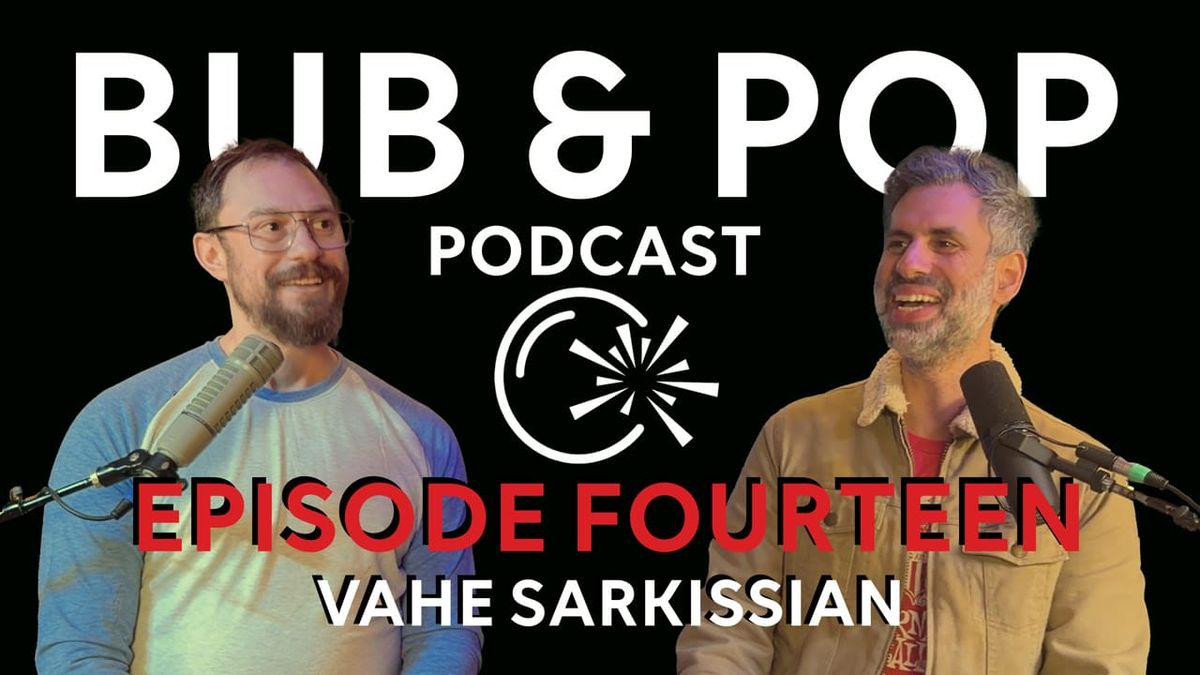
Bub & Pop | Episode 14: Vahe Sarkissian (recorded March 3, 2026)
Vahe Sarkissian is a veteran of the Philadelphia music scene and plays across genres: rock, jazz, and original interpretations of Armenian folk music that sound like jazz fusion.
He's a two-hand tapper, but not the kind you're thinking of. For him it's composition, not a party trick, and he throws away the pieces that only exist to prove he's tapping. His last LP, Curcuna, is named for a Middle Eastern rhythm he'll argue is in 10 and not 5, and he walks us through exactly why. We get into opening at Ardmore for Greg Howe, Richie Kotzen and Victor Wooten; tendonitis, and learning he doesn't have to be a hero on every gig.
He plays twice for us: an Armenian original, and an arrangement of "Eleanor Rigby" that owes a direct debt to Stanley Jordan. Stay for the part where Stevie Wonder sits down in front of his band at NAMM and listens for twenty minutes, and look out for a new trio album some time next year.
An audio-first version of this podcast is available here.
Vahe Sarkissian | Instagram | Bandcamp | X | Curcuna (2022)
Also mentioned: Roger Mgrdichian | Matteo Mancuso at Ardmore Music Hall
Bub & Pop | Website | YouTube | Instagram | TikTok | Facebook | X | Threads | LinkedIn | Audio-first | Discord
Host: Matt Hoffman | Producer: Tedd Kanakaris | Location: The Boom Room
TRANSCRIPT (lightly QC’ed)
Matt Hoffman [0:20]
Hi, I'm Matt Hoffman, and this is the Bub & Pop podcast. Our guest today is Philadelphia-based guitarist Vahe Sarkissian. Vahe plays in a bunch of different projects, both original and covers-oriented. In one of those projects, he plays original electric guitar-driven arrangements of Armenian folk songs. It may sound weird, but actually, it's fucking awesome. He released an album called Curcuna — that's C-U-R-C-U-N-A — that I think perfectly encapsulates that fusion of electric jazz guitar with the Armenian folk traditions and rhythms. He also performed a couple of tunes, one original arrangement of an Armenian song and one cover that you will definitely recognize. And it's a great conversation, and for those of you who don't know Vahe, I am happy to introduce him to you.
[Performance: an Armenian original]
Matt Hoffman [3:34]
So I recognize that tune from your last full LP, Curcuna, is that the right pronunciation?
Vahe Sarkissian [3:43]
Yeah, and that word refers to a certain Middle Eastern rhythm that's used commonly in music from that area, but it's more of a 10-8 kind of a rhythm, so it kind of made sense for the album since it was Middle Eastern based.
Matt Hoffman [3:58]
Yeah, yeah. I'm trying to think of how you count that.
Vahe Sarkissian [4:03]
So the typical rhythm is one, two, three, one, two, one, two, one, two, three. So it's two subdivisions of five. So a lot of times when I play with people, they count in five and they think of it in five, but I always say it's actually 10 because the subdivisions are switched around in a second grouping. So if it was just five, I think I would feel it as one, two, three, one, two, one, two, three, one, two, one, two, three. But the way it switches around on a second time, it's a longer phrase before it resets. It's making it 10. So that's kind of my argument as to why I call it 10 instead of five.
Matt Hoffman [4:37]
That's interesting. And do you feel like you hear that distinction elsewhere in like Western music, like say metal or anything like that?
Vahe Sarkissian [4:44]
Yeah, I think it's, the difference between the music from that area when you do an odd time thing, it's based on a more organic kind of, it's based on dance. It's based on dance steps and like they do like group, like circle kind of dancing and the amount of steps they do matches the music and matches the beat of it. So as opposed to maybe a more compositional thing, if you hear it in a metal context or in any other context, it might be a little more intentional compositionally, but this is just more of a like village dancing.
Matt Hoffman [5:21]
Sure. Well, and I'm sure that, electric guitar wouldn't be part of the traditional instrumentation, like what might it have looked like, in more of the Armenian kind of folklore tradition?
Vahe Sarkissian [5:33]
You would see an oud, which is an 11-string, fretless, watermelon-shaped instrument. And that instrument is actually, I believe it's a Turkish instrument, but you know, it's all close in the same region. So they use that music. Darbuka or dumbek, we call it dumbek, just a, a lap percussion kind of thing. They play clarinet. And then more specifically in Armenian music, you have other, I guess, woodwind instruments. I believe they are like a duduk. I'm not too familiar beyond it, but they have other things. But I mean, in terms of instruments you would see even in Western culture, yeah, you have a lot of clarinet in that music.
Matt Hoffman [6:11]
Gotcha. And right, I've seen you perform with, is it Roger?
Vahe Sarkissian [6:15]
Roger, yeah.
Matt Hoffman [6:15]
Right, on oud. I don't know if I've seen you with a clarinet, but I'd imagine as part of the, the more sort of Middle Eastern set, you...
Vahe Sarkissian [6:23]
Yeah, so I try to, I try to, I guess, imitate the clarinet with the electric guitar because they can get that kind of smoothness of it and sustain of it that, but the really percussive, like, the element of a stringed instrument that Roger can get. And I am terrible at playing fretless instruments, so I don't even try.
Matt Hoffman [6:40]
Okay, that's fair. Do you play, like, much slide or anything like that?
Vahe Sarkissian [6:44]
I'm terrible at it.
Matt Hoffman [6:44]
Yeah, yeah, yeah. It's, I wouldn't even begin to think about it, but who is it? Like, the guy from Consider the Source goes from fretted to fretless.
Vahe Sarkissian [6:53]
Yeah, yeah, and they're such a great... I remember I was in an instrumental trio years ago, and I think we played with them at the Fire in Philly. Yeah. And my first time seeing that group, and they were blown away, and just seeing them when they kind of first started, and they were playing just, like, very small rooms and just getting out, and now hearing about how they're doing as well as they are, and turning around, and really built a name for themselves doing that kind of thing. It's super cool.
Matt Hoffman [7:19]
Yeah, yeah, for sure. Well, so I saw you were playing a Strat before. Is that... And I think I've seen you play a Tele as well. Are you pretty much exclusively a Fender guy?
Vahe Sarkissian [7:29]
Yes, in terms of the traditional instruments that I use, those... I do have a guitar from a company called FM Guitars. It's, like, a kind of ergonomic, kind of smaller-bodied guitar, and it's great, especially for, like, tapping, the two-hand tapping stuff, and doing some slap kind of stuff on there. And then, so that's another guitar I have in my arsenal, and then I have this Gretsch guitar that I absolutely love, and it's one of those guitars that you will sound like a legit jazz player the second you pick it up. Like, the tone is there, and I just kind of phrase like it, so I love that guitar, especially for playing that stuff.
Matt Hoffman [8:02]
Oh, that's awesome. Yeah. And have you, like, raised the action or tweaked that?
Vahe Sarkissian [8:06]
No.
Matt Hoffman [8:06]
Okay.
Vahe Sarkissian [8:06]
In my setup, I have to have absolutely low action, like, stupidly low. I could even... I don't even mind slightly thicker strings, but my action has to be, like, ridiculously low, and I just try to get the tones I need just from, from the touch of it and from the equipment.
Matt Hoffman [8:23]
Gotcha. And is the low action just for the tapping?
Vahe Sarkissian [8:26]
It's for all of it. It's for the tapping. It's for dealing with some tendonitis as I get older. It's for just easeability of legato playing, which I like to do a lot of. And I've learned to dial back my playing a lot, so I still try to get, like, a dug-in sound, but I almost, like, air guitar when I play, just to keep everything kind of loose and easy and just to kind of help sustain me on longer sets.
Matt Hoffman [8:52]
Sure. Are you using... When you're using a pick, are you using a heavy one or a light one?
Vahe Sarkissian [8:56]
Yeah, I would say moderately heavy.
Matt Hoffman [8:58]
Gotcha. Yeah. Well, so, who are some of the guitarists that really sort of... Because as I think about it, there are a few different paths you've kind of grown along in parallel. There's obviously, the sort of Armenian folk tradition, but more just straight-ahead jazz and kind of fusion and rock and things like that. Who are some of your kind of go-to guys along the way?
Vahe Sarkissian [9:22]
So, early influences are pretty straightforward. I wish I could tell you about the guitar player you've never heard of, but big David Gilmour guy growing up, Jimmy Page, Eddie Van Halen, and a lot of 80s rock that I'm too embarrassed to say I listen to.
Matt Hoffman [9:42]
Fair.
Vahe Sarkissian [9:42]
But as a teenager, I just love that stuff, and, still guilty pleasure-wise do. You know, and then influences as I got older, and I would say more current influences, like Kurt Rosenwinkel, Scofield, and Metheny, but really specifically Metheny Trio.
Matt Hoffman [10:01]
Okay.
Vahe Sarkissian [10:02]
More so than... I mean, I actually like the synth-y kind of sounding stuff he does, too, but really, when I listen to Metheny, it's the trio stuff. It speaks to me because it invokes emotion. Like, when I hear him just even play a simple vocal-like line, it just makes me feel something.
Matt Hoffman [10:19]
Yeah. Didn't they just release an album?
Vahe Sarkissian [10:22]
I saw that he's doing something kind of in that realm that's a little, I don't know if it's straight ahead, but it sounds really cool.
Matt Hoffman [10:31]
Yeah, yeah. I think the first time I saw him was on the Way Up tour at, like, the Tower, I want to say.
Vahe Sarkissian [10:40]
Oh, cool.
Matt Hoffman [10:41]
Yeah, and that was, like, obviously group, and I know that Lyle Mays and all that can be a little sort of polarizing, but, like, it was wonderful, and he had just started playing with the percussionist I think he's been playing with ever since.
Vahe Sarkissian [10:53]
Okay, okay.
Matt Hoffman [10:53]
But I'm forgetting his name. I want to say Antonio Sanchez, maybe?
Vahe Sarkissian [10:59]
I think so. I think that sounds better. Yeah, yeah. I saw him play a couple years ago, just a solo thing, and it was great. I just have a short attention span for a solo concert. I want to see a full band.
Matt Hoffman [11:10]
Yeah, yeah.
Vahe Sarkissian [11:11]
Coincidentally, I saw Al Di Meola that same year doing a solo thing.
Matt Hoffman [11:15]
Oh, wow.
Vahe Sarkissian [11:15]
Once again, amazing show, but I had kind of a short attention span.
Matt Hoffman [11:18]
Yeah, yeah, that's fair. What is it like for you performing solo versus with a group? Is it different for you on stage?
Vahe Sarkissian [11:25]
Yeah, I think the room has to be very quiet. To me, it ruins the kind of orchestration of playing a solo piece. If you hear any sound, it cuts out the frequency. A band can kind of cut through that. So there's that, and then the whole vulnerability aspect of playing solo is definitely... It's a little less forgiving in some ways than playing in a band. In other ways, it's more forgiving because I could say I meant to do that, and if the time skews a little bit, it's okay because no one else is...
Matt Hoffman [12:03]
Yeah, well, what I meant by that is... Yeah, exactly.
Vahe Sarkissian [12:04]
Yeah, yeah. But yeah, no, it's different. That's kind of an avenue I want to explore more, playing solo. When I say playing solo, I mean specifically playing to a listening audience. I mean, I do solo gigs, but being a working musician, sometimes it's more in the realm of being a background kind of thing, but I'm talking about performances where there's a listening audience.
Matt Hoffman [12:28]
Yep. Well, and from my perspective, so where I first crossed paths with you is the Matteo Mancuso show in Ardmore, and I remember you played a tune or two solo. It seemed like a fairly attentive crowd. I mean, if they're there to see Matteo Mancuso, there are probably tons of us.
Vahe Sarkissian [12:41]
Music Hall always is, and that venue has been really good to me. And they've been kind enough to call a local guy like me and have me open up for some pretty big names there. And I've got to open up for Greg Howe and Richie Kotzen, and I got to open up for Victor Wooten, and a good friend of mine and also a fellow musician I work with, Glenn Mirazzo, was kind enough to kind of... He knew Victor's people a little bit, and he was kind enough to kind of put a word in, and then that helped Ardmore Music Hall kind of get the okay.
Matt Hoffman [13:21]
That's awesome.
Vahe Sarkissian [13:22]
Yeah. So that was nice. And going back to influences, Victor Wooten is actually a big influence. His four-string solo record, Show of Hands, even though I'm not a bass player, was a big influence for me.
Matt Hoffman [13:33]
Interesting. I was going to say more so than... I'm forgetting, it's either his brother or his cousin, the guitar player.
Vahe Sarkissian [13:38]
More so than Reggie. Yeah, Reggie. I knew about Reggie through Victor, and then I saw the Wooten Brothers years ago at the TLA in 2004 or something like that, and I saw Reggie doing all his stuff. And I'm like, oh, that's super cool that it wasn't just Victor. And apparently Victor got that from Reggie, because Reggie was the oldest one in the family.
Matt Hoffman [13:57]
Oh, interesting. Yeah. Yeah, I saw Victor... I don't know if he opened for it, but he definitely played with Cory Wong's band.
Vahe Sarkissian [14:05]
Yes, I saw that. Yeah. Did he play the Fillmore or somewhere like that?
Matt Hoffman [14:08]
I want to say the Fillmore, yeah. Yeah. Yeah.
Vahe Sarkissian [14:10]
Hell of a...
Matt Hoffman [14:10]
That was a couple years ago, too. Yeah. Yeah, that's right. That's right.
Vahe Sarkissian [14:14]
And that's post-Dystonia. You know Victor Wooten has dystonia, so he's limited on his playing, apparently.
Matt Hoffman [14:21]
Oh, wow. I didn't know that.
Vahe Sarkissian [14:22]
Yeah, and he's such an incredible musician. Sometimes when he's slapping, I think he's just making noise and making grooves, and it still sounds amazing in music. Yeah. Yeah. It's a neurological thing where... I don't know exactly what the details are, but something is not connecting and the hands are not working in the same way.
Matt Hoffman [14:40]
Oh, geez. Yeah. Well, what does some of the wear and tear look like for you over the years? We were talking before about tendonitis and...
Vahe Sarkissian [14:45]
Yeah, overuse is a serious thing. I noticed a little bit of it about 10 years ago, but it was pretty marginal. I switched to, like I was saying earlier, stupidly low action and changed my technique to still get a dug-in sound, but without actually physically having to play too hard. Learning that I don't have to be a hero and play everything all the time, and learning to utilize the perks of playing in a 10-piece band if I'm doing a gig with a larger band. I don't have to... They could cover some ground. I could play a single line and that could be fine. And it kind of worsened in the past couple of years. I don't know, due to age or just due to whatever. Like I was saying earlier, I think you either have to perform full-time and not practice as much and work on the creative side of music, or you got to use your time to work on the creative side and practice and maybe not gig like five times a week.
Matt Hoffman [15:40]
Yeah.
Vahe Sarkissian [15:40]
And I like to do both.
Matt Hoffman [15:42]
Yeah, yeah, that's right. Why choose?
Vahe Sarkissian [15:45]
Why choose?
Matt Hoffman [15:45]
But I feel like I don't see you put a lot of your practice and things like that on social media. It's almost like for some people there's kind of the third path of just putting it all out there on social and for people to look at. I don't know, what's your experience of that life?
Vahe Sarkissian [16:00]
I used to do that stuff. I think that's great and totally fine. I just... As I got older, I kind of like... The wow factor stuff that people post on social media became kind of like... It became this thing of, okay, that's great. You sound awesome playing in your bedroom for 10 seconds, but what do you like when you play live?
Matt Hoffman [16:33]
Sure.
Vahe Sarkissian [16:34]
And can you go and play with a group of people that you've never played with before, no rehearsal and get through a gig and sound solid and those kind of things. So I like to mainly post live clips because that's... As a working musician, that's kind of the important part of all the practice, it's the utilization of it.
Matt Hoffman [16:55]
Yeah, yeah, absolutely.
Vahe Sarkissian [16:57]
So a guy that I loved on Instagram, I still do, Mateus Asato, obviously he's the guy, but he always would... Someone like him who would post things of him, whatever he was working on, but he obviously is a legit player and to me, that was evident in any of his posts. And he's a guy that kind of made it known just through, I think, his Instagram presence initially. So that kind of always... So if I do post something of me playing at home, I try to make it like a compositional thing or something that's a musical. I mean, guilty as charged every now and then, I'll put the best 10 seconds of what I came up with as well. But yeah, I found the internet world to be a little bit just bombarded with guys who are not necessarily performers. And I think the world is missing that. That wasn't the case in the 70s, I imagine.
Matt Hoffman [17:54]
Yeah. Well, it also kind of becomes a question of why you're doing it and what you're after, and so I watched this documentary recently about the first iteration of Jimmy Buffett's band. And they were partying and doing all the crazy stuff and whatever, but they were solid. There's that kind of craft that I think is maybe... That might have been the why behind the why back in the day, but now sometimes it's like, people don't even think about the why. It's like, well, whatever, I can play this fucking blazing thing and I'm gonna throw it on YouTube and... What about playing with a singer? What about playing in the context of a song?
Vahe Sarkissian [18:34]
Yeah, yeah. I grew up... Even when I think of the guitar solo... And now, going to jazz... I always use the term jazz adjacent, would be more my speed than I would say a straight ahead jazz player. But going in more of a jazz adjacent realm in the latter part of my guitar playing life. I do longer solos, but the reasoning for that is because you're making a conversation and you're developing your chance to make a statement and there's something musical behind it. But ultimately, when it comes to the guitar solo, I grew up listening to rock bands and songs that had a cool iconic solo in it. So the solo was still compositional in some way or it was in the context of a song, and it wasn't just kind of like this babbling kind of thing. So to me, the idea of playing guitar in the context of a band or song is still a very important thing. And sometimes there's a lot of great players that can play things that I can never play, but it'll be nice to see them play in the context of music that we could actually all enjoy.
Matt Hoffman [19:42]
Now, when it comes to a solo that you're gonna record, is that starting with you and a pen and paper, you and a guitar, just kind of playing whatever comes to mind versus coming in intentionally?
Vahe Sarkissian [19:56]
Good question. So in the studio, I go a bit more on the compositional side with solos just because I want to make sure it's the right thing for the record. And there's only a million takes I can do and stir up a studio. So what I'll do is at home, I'll have the track has been recorded, all the guitar parts have been recorded, and let's say there's a set amount of bars, 32 bars, let's say, whatever, for a solo. I'll start improvising at home 10 times, 20 times, however many times. Eventually, the direction kind of writes itself. I start repeating certain things or certain things stand out to me, and that helps allow me to compose. It's not necessarily an exact composition. It's more of a directional composition, peaks and valleys. I know where I'm going. I'm starting off with this theme, developing into that climactic shit and this and that. Sometimes it might be very compositional, but mostly it's just more directional in terms of the composition. But yeah, I do try to have actual intention with what I'm playing on a recording. Live can be more forgiving. I can stretch live. On a recording, I don't want this solo to go. Some people might listen to this stuff and say, what's this guy talking about? In my mind, I don't like the solo to go way, way too long. Considering that's an instrumental guitar album, I think there's liberties there. I made a holiday album, a Christmas album, which is more of a pop thing recently, but I still did my guitar thing in there because that's, why not? But the solos were pretty compositional, and even though I had some things that were, I think, something guitar nerds would like, I did try to think of it from the realm of the song, and I did try to channel some inner Brian May and that kind of thing.
Matt Hoffman [21:45]
Yeah. Well, and I'm a massive Christmas music fan.
Vahe Sarkissian [21:49]
Of course.
Matt Hoffman [21:49]
There's like a specific type of Jew who loves Christmas music.
Vahe Sarkissian [21:54]
That's great.
Matt Hoffman [21:54]
So I'm always looking for just new, good Christmas music.
Vahe Sarkissian [21:54]
Cool.
Matt Hoffman [21:54]
Yeah, I dug the EP.
Vahe Sarkissian [21:59]
Oh, thank you.
Matt Hoffman [22:00]
It was really good.
Vahe Sarkissian [22:01]
Thank you.
Matt Hoffman [22:01]
Well, do you want to play another tune while we're...
Vahe Sarkissian [22:04]
Oh, man. Sure.
[Performance: "Eleanor Rigby"]
Matt Hoffman [23:28]
How similar would you say your arrangement is to Stanley Jordan's arrangement?
Vahe Sarkissian [23:31]
It was my attempt at figuring out what he was doing and then not being able to figure out what he was doing and then just saying, oh, let me just come up with the rest. Let me just come up with a version of this.
Matt Hoffman [23:40]
Yeah. When did the solo kind of two-hand tapping thing come into play for you?
Vahe Sarkissian [23:44]
I was going to my junior year of college at UArts and kind of in this place in my guitar playing where I kind of wanted to make sure I stood out in some way. And I was a rock player in a jazz school. And at the time, the jazz thing didn't really make sense to me. And I was just kind of noodling around with a pattern. Can I play the pattern?
Matt Hoffman [24:14]
Yeah, please.
Vahe Sarkissian [24:14]
Let's see if I even remember it. And I was way cleaner with it back then. I haven't even played that in forever. But I was messing around with that pattern. I just kind of developed a whole kind of... It started off as an exercise, developed into a composition. And that's probably the first thing I wrote. Then the second thing I wrote was similarly based patterns, but utilizing all sorts of the kind of Mediterranean and ethnic rhythms. It's a piece I play off and live. I might have even played it when you saw me at the Matteo Mancuso show. I don't think I even have a name for it. But my close friend and my go-to drummer Josh Orlando and I, we have a kind of a duo version we put of that tune. But I play that a lot. And then the third thing I came up with was... I didn't come up with it, but the third tapping thing I learned was Victor Wooten's version of Overjoyed off his Show of Hands album. I just kind of tried to figure out his version of it and couldn't figure all of it out and made up my own thing. And then from there, it developed into... I had a Bohemian Rhapsody interpretation I did.
Matt Hoffman [25:40]
I've heard that, yeah.
Vahe Sarkissian [25:40]
I'd played that. Matteo Mancuso show. I had a human nature thing I did years ago. And one of the things as I got older with the tapping stuff, in the beginning, there was this kind of thing of like, look at how cool this is I'm tapping. And I would listen back. I'm like, this kind of sounds stupid. Why don't I just play that like a regular? So I started being mindful of utilizing it only if it's something that's useful or actually sounds good or makes sense to do. So half the pieces I wrote, I kind of threw away because I just thought that there was more for the show of the fact that I'm tapping, but it didn't really make musical sense beyond that. But yeah, I was about 20 years old. That's kind of how it started.
Matt Hoffman [26:21]
Okay.
Vahe Sarkissian [26:21]
19, 20 years old.
Matt Hoffman [26:22]
And do you feel like that approach lends itself to the Jurgen type music or any of the...
Vahe Sarkissian [26:28]
The percussive element of it. Yeah. You know, I like to just...
Matt Hoffman [26:35]
Yeah, please.
Vahe Sarkissian [26:35]
Let me see if I can even come up and play something without saying.
Matt Hoffman [26:48]
So it's like a 10-8 rhythm.
Vahe Sarkissian [26:48]
But you know, even something like that where I get a little bass line and then like the kind of tappy percussion, that's kind of what I like about it. That to me is what sounds cool. Yeah. Yeah.
Matt Hoffman [26:57]
Well, and right. Like a blues player kind of making similar like percussive rakes and stuff on a Strat. Like it's a...
Vahe Sarkissian [27:03]
Utilizing... That's the cool part of the guitar.
Matt Hoffman [27:06]
Yeah, yeah, exactly.
Vahe Sarkissian [27:08]
Like that childish kind of like enjoyment of it. You know, making noise with it.
Matt Hoffman [27:11]
Oh, it's the best. Yeah, yeah. Do you play through like a minimal kind of rig? Do you have a lot of... Yeah.
Vahe Sarkissian [27:16]
Like actually when I... The Eleanor Rigby I played earlier, I normally would have had a delay pedal covering something. So that was cool to play kind of a little more raw that way. You know, especially with the tapping stuff, I always have slight compression and some delay just to kind of sustain it because it can be very pingy.
Matt Hoffman [27:33]
Yeah, yeah.
Vahe Sarkissian [27:34]
So a lot of the guys that do the tapping stuff, I noticed they have a very dry sound. That to me just sounds too sterile. What I liked about Stanley... What I like about Stanley Jordan is that his tapping was musical compositional improvisational, which I cannot improvise in that style. That's not something I'm able to do. For me, it's compositional. But he was just a player who played that way.
Matt Hoffman [27:58]
Yeah.
Vahe Sarkissian [27:58]
And he had a beautiful lush sound. He was the one that said you should use thin strings, compression, and like a healthy delay and reverb to kind of wash it out a bit. But it makes it, I think, sound more musical.
Matt Hoffman [28:13]
Sure.
Vahe Sarkissian [28:14]
Adds a beauty to it, you know?
Matt Hoffman [28:15]
Well, and I mean, that's also the thing that you mentioned about Stanley. Like that's not Stanley getting up there trying to do anything besides be Stanley. I feel like Eddie Van Halen was the same way.
Vahe Sarkissian [28:25]
Yes, exactly.
Matt Hoffman [28:26]
It's flashy, but that just happens to be how he played it. That's just what they did.
Vahe Sarkissian [28:30]
And Eddie is a prime example. Well, I guess Stanley Jordan would be too. But from the rock realm, Eddie was a... If you ever watch old Eddie interviews, he didn't really listen to anybody. I think he listened to Clapton, which he sounds nothing like.
Matt Hoffman [28:43]
Right.
Vahe Sarkissian [28:44]
And other than that, he just was kind of inventing not only physical aspects of the guitar with the electronics of it, but also it's like the stylistically, and he was just coming up with his own thing, and this is just what he did.
Matt Hoffman [28:58]
Yeah. And that's what makes it cool.
Vahe Sarkissian [28:59]
Yeah, exactly. It's musical, it's intentional, it's within the context of a song.
Matt Hoffman [29:03]
Yeah, it is. It swings. It swings.
Vahe Sarkissian [29:07]
Crazy. It swings. Eddie swings.
Matt Hoffman [29:08]
Absolutely. I think that's the biggest thing that some of the Eddie clones miss.
Vahe Sarkissian [29:12]
Yes.
Matt Hoffman [29:12]
He swings like nobody's business.
Vahe Sarkissian [29:13]
They miss his phrasing, and they miss his feel and his swing. Yeah.
Matt Hoffman [29:16]
That's it. Yeah, for sure. Yeah. Well, so what else do you have cooking now? I think that holiday EP was the last release you put out.
Vahe Sarkissian [29:25]
Yeah, that was kind of like a last-minute impromptu kind of thing. I've been doing a lot of work with this fantastic singer, Camille Kay, and her, along with a close friend of mine, Sabone, lended their fantastic vocals to it. But I want to do something. I work with singers, and I work in pop contexts a lot, so I want to kind of utilize and showcase that. But the next thing I'm working on is a trio album with my drummer, Josh Orlando, who's just like a fantastic ... He's like a virtuoso drummer, but he just plays pocket, and that's what I love about him. And then it's with him, and Sam Nobles is a bass player I've been working with. He's just ... He can play upright, electric. He's musical. He's understated, but he can play the most beautiful solo over changes you've ever heard. And we just connect really well. So I'm working on a trio album with those guys, and a couple tracks have already been cut. It's going to have some of that ethnic influence, but I'm just going a little more of a ... I don't know. It's going to be a little more jazz-oriented, this one as well. Still electric, guitar-driven. It's not going to sound ... I'm not saying it sounds like Metheny Trio, but that's kind of like the blueprint. I kind of think to myself, if this was a more electric guitar and pocket-oriented version of what that invoked emotionally for me, that's what I'm trying to channel. It won't sound anything like it, but that's the blueprint.
Matt Hoffman [30:54]
No, that's super cool. Are there any new tunes that you've worked up, like a solo arrangement for or anything?
Vahe Sarkissian [31:00]
No.
Matt Hoffman [31:00]
Ah, okay.
Vahe Sarkissian [31:00]
Unfortunately not.
Matt Hoffman [31:03]
But next time ...
Vahe Sarkissian [31:05]
Yes, absolutely. I'm setting up our next podcast. For sure, for sure. Next time I will.
Matt Hoffman [31:10]
Any shows coming up?
Vahe Sarkissian [31:13]
I'm playing at Shere-E-Punjab. You know Shere-E-Punjab Live? Yeah. Super cool place. It's an Indian restaurant that has a venue attached to it. Yeah.
Matt Hoffman [31:20]
Is it in Kennett Square?
Vahe Sarkissian [31:21]
No, it's in Media.
Matt Hoffman [31:23]
Ah, okay.
Vahe Sarkissian [31:23]
I'm playing there April 23rd.
Matt Hoffman [31:25]
Okay.
Vahe Sarkissian [31:25]
I'm playing there with the trio that will be ... That's in the process of recording this album.
Matt Hoffman [31:30]
Oh, awesome.
Vahe Sarkissian [31:31]
We'll be playing some of the new tunes off there.
Matt Hoffman [31:34]
That's cool.
Vahe Sarkissian [31:35]
It's a great venue. And it's a great place for me to kind of experiment with some new things there.
Matt Hoffman [31:41]
Yeah, yeah, for sure. April 23rd, I actually think I'm free. So I want to come out. It's a Thursday. Yeah, dude, I definitely want to check it out.
Vahe Sarkissian [31:48]
And then I'm playing a festival in Collingswood in May, but I plan on having some bigger shows this year as well.
Matt Hoffman [31:57]
Super cool. I can't wait to hear about them. So you were at NAMM in January. Is that right? How long have you been going?
Vahe Sarkissian [32:04]
This is my third time going.
Matt Hoffman [32:06]
Okay.
Vahe Sarkissian [32:06]
The last couple of years were especially eventful.
Matt Hoffman [32:08]
Oh, how so?
Vahe Sarkissian [32:10]
Just meeting some great companies. And like I said, this one company, FM Guitars, that I use their guitar, and I met them last year, and they were cool enough to have me play at their booth this year. And Felix Martin is the maker of this guitar, and he's like a tapping virtuoso that's really made a name for himself, especially online. And he's a super cool guy. So I got to perform at that booth this year. Another milestone, I would say, this year, I was working in Camille Kay's group, and then we're about to play the Monster Cable booth. And then somebody from the booth says, you guys should start playing soon. Somebody's coming by. So I just figured some industry person. I'm like, all right. So I think I made mention that we should get going. I'm kind of noodling around, tuning up. And the video is on Instagram somewhere, I think, on her page. But you'll see it's kind of just like dicking around. And all of a sudden, we see it's Stevie Wonder with his entourage.
Matt Hoffman [33:09]
Wow.
Vahe Sarkissian [33:10]
And our buddy KJ McNeil was also playing in a group. KJ is a multi-instrumentalist and wonderful singer, who coincidentally works with Stevie, singing backup for him. But this was completely unrelated to that. Stevie happened to be friends with the owner of Monster Cable, from what I understand. So he was going to stop by the booth to say hi. So we see him with his entourage. And we're like, oh my god, Stevie Wonder. We're like, we should start playing something. No sound check. We're just going to start playing a Pink Floyd song, us and them. And as this is happening, they're making room for him. So he's not going to just walk on by. He's going to sit down. He sat down for like 20 minutes.
Matt Hoffman [33:50]
Wow.
Vahe Sarkissian [33:50]
And he listened, and he shook his head. And in that moment, I felt like true happiness. I felt truly light. For me, it was a definite milestone, just the fact that he was listening.
Matt Hoffman [34:03]
Yeah.
Vahe Sarkissian [34:03]
And there.
Matt Hoffman [34:07]
That's amazing.
Vahe Sarkissian [34:08]
So yeah, that was a very worthwhile NAMM. I mean, there was other cool things, but just that alone was enough for me.
Matt Hoffman [34:17]
Yeah. And it sounds like you played it cool. You didn't do like a Jeff Beck Superstition kind of thing?
Vahe Sarkissian [34:23]
No, we played it cool. I don't think we did. No, we didn't. We just played what we would normally play. We played a Floyd tune, Miss You by the Rolling Stones, maybe a couple pop tunes.
Matt Hoffman [34:33]
Excellent. Yeah. You never pander.
Vahe Sarkissian [34:35]
Yeah. At one point, I was like, oh, I should play something. I'm like, no, I should do the opposite.
Matt Hoffman [34:39]
Yes. I like it. I like the way you think.
Vahe Sarkissian [34:43]
I should do the exact opposite and just sit in the pocket, you know?
Matt Hoffman [34:44]
Oh, man. That's super cool.
Vahe Sarkissian [34:46]
Yeah.
Matt Hoffman [34:46]
But that was fantastic for sure. Wow. Yeah. Talk about a highlight of just years of the festival. Yeah.
Vahe Sarkissian [34:52]
And it's just super cool. You're walking by. You see Paul Gilbert being interviewed. You see Mateus Asato just like checking out something. You turn around. He's like right there. And it's kind of a surreal, I don't want to say it's a fantasy, it's a reality you're there, but if the rest of the year can be what that one weekend is, it would be like a dream for a musician.
Matt Hoffman [35:23]
Oh, I believe it.
Vahe Sarkissian [35:24]
You know?
Matt Hoffman [35:24]
I can't even imagine. Yeah. Someday, I'll get out to NAMM.
Vahe Sarkissian [35:27]
Yeah. Well, let me know when you're there.
Matt Hoffman [35:29]
Dude, absolutely. Yeah. Yeah. Dude, really appreciate you making the time.
Vahe Sarkissian [35:32]
I appreciate the invite.
Matt Hoffman [35:33]
Yeah. This was fun. Thank you.