
Episode 12: Mike Goodman
Eggy bassist Mike Goodman on the band's jazz roots and jam-scene rise, and on leaving the road in 2025 to get sober — recorded at Music on the Mountain.
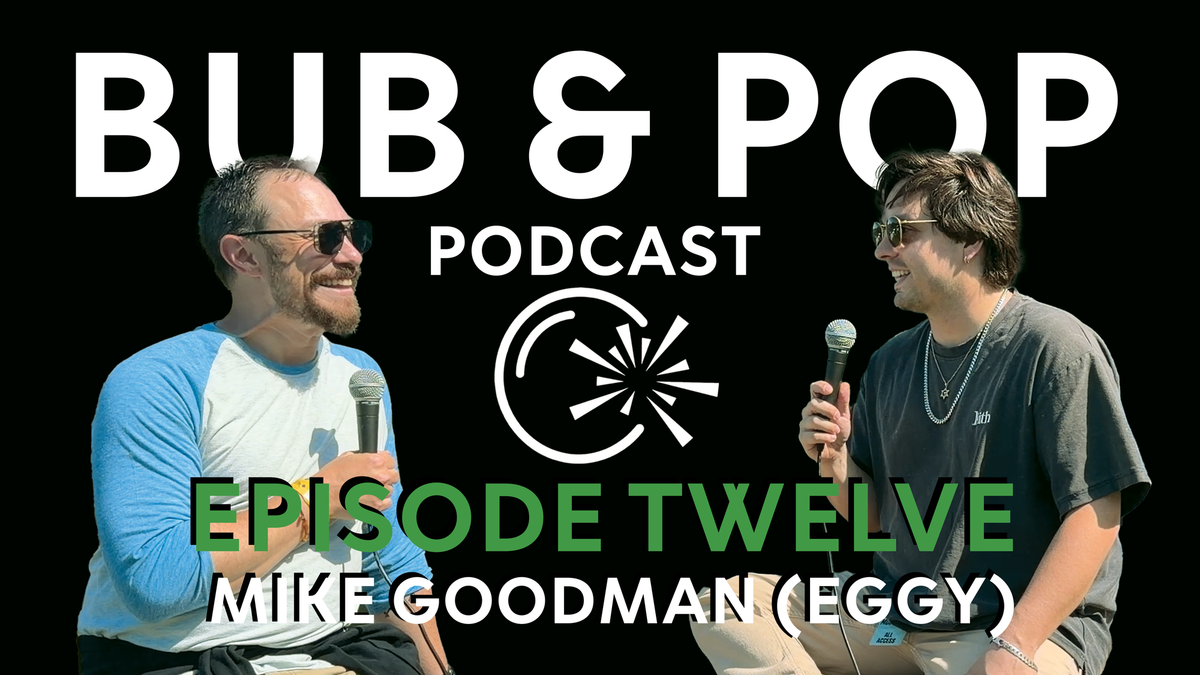
Bub & Pop | Episode 12: Mike Goodman (recorded May 16, 2026)
Mike Goodman is the bassist and one of the voices of Eggy, the Connecticut-based four-piece who've turned jazz training and a deep love of the Grateful Dead and Phish into one of the most exciting improvising bands in the jam scene. Recorded at the Divided Sky Foundation's Music on the Mountain festival in Ludlow, Vermont, this conversation moves from the band's rise – 80-to-100 shows a year, the King Gizzard cover ("Interior People") that earned a nod from Trey Anastasio, and the song-first philosophy behind their jams — to something more personal. Mike opens up, with real candor, about stepping away from the road in 2025 to get sober, the friends and organizations that carried him through it, and what it feels like to come back to the music he loves with a clearer head.
If you or someone you love is struggling, Backline and the Divided Sky Foundation are two of the resources mentioned in this conversation.
An audio-first version of this podcast is available here.
Eggy | Website | Instagram | Facebook | X | YouTube | Spotify
Bub & Pop | Website | YouTube | Instagram | TikTok | Facebook | X | Threads | LinkedIn | Audio-first | Discord
Host: Matt Hoffman | Producer: Tedd Kanakaris | Location: Music on the Mountain Festival
TRANSCRIPT (lightly QC'ed)
Matt Hoffman [0:25]
Hi, I'm Matt Hoffman, and this is the Bub & Pop podcast, where we talk about music, careers in music, life, the universe, and everything.
Matt Hoffman [0:36]
So what's it like for you now — getting on stage, playing more in what you might call the rock arena? That process of going in with what you know, but also trying to forget what you know and just be in the moment.
Mike Goodman [2:47]
It works perfectly with what we're trying to do. We go into every show not knowing exactly how it's going to go, and that freewheeling, free-spirit energy is kind of the embodiment of the genre we're in. Like I said, it's the perfect marriage of the jazz thing that I studied and the rock and roll I grew up with. I really couldn't ask for a better outlet for my expression.
We take a lot of those sensibilities — like, we're going to tease this song, or here's the melody of this other thing — which is taken directly from the jazz idiom. You listen to any of the greats and it's, oh, here's a little quote from "Stella by Starlight." We get to straddle the lines of jazz and rock and indie and pop, and the jam scene is so open to hearing all of it. You can go from funk to pop to jazz to reggae all in one set, and the fans are so receptive. That's a credit to the fans for being so open-minded.
Matt Hoffman [4:47]
One of my favorite things about you guys is the way you improvise. I'm not fully conversant with your whole catalog, but I have a great time listening to you play anything. You're essentially composing on the spot, and it's clear you're all really in sync.
Mike Goodman [4:59]
It helps that we're all best friends doing this. We're bandmates and we work well together, but they're also my best friends, and that makes playing music — and touring — so easy. Being in confined spaces and on the road for a long time with the people I love the most just makes it a good time. My hope is that comes out in the music.
Matt Hoffman [5:44]
I heard an interview Rick Rubin did with Flea and Anthony Kiedis, and they talked about how John Frusciante, Flea, and Chad Smith have this wonderful blurring musically — but Anthony and Flea have been best friends since they were pre-teens, and playing together is almost a continuation of that. You guys must have been friends before you were playing.
Mike Goodman [6:00]
Oh, definitely. I have memories of Jake and me sitting in the band room in high school, watching YouTube videos of different artists and being like, man, isn't this awesome? I can't wait until we can do this someday. And I think we're well on our way.
Matt Hoffman [6:41]
When did Eggy really start to kick in and become the majority of how you spend your time?
Mike Goodman [6:48]
It really started to coalesce when Alex joined us. He didn't go to high school with us — he grew up in Chicago and went to Berklee, but we kind of missed each other there. I remember the first rehearsal when he came down and we jammed for the first time; we all looked at each other like, oh, this is special. And we were all really serious about wanting to do it, which is a huge barrier for a lot of bands — if you have a member who isn't ready to quit their job and go on the road. We were all really serious about doing this for our careers and our lives. When Alex came in, we were like, okay, we can do something with this.
Matt Hoffman [8:15]
When was the last time you had what you'd call a day job?
Mike Goodman [8:19]
It's been a while — definitely before COVID. I used to work at a comic book shop, which was a great, super-flexible job. I read a lot of Doctor Strange back then; Spider-Man was putting out some really cool stuff. I still collect comic books — I have a closet full of stuff I take good care of, a lot of great '90s books, the Infinity Gauntlet stuff, symbiote Spider-Man comics. The shop I worked at specialized in variant covers — we'd hire artists to do specific covers for important books and make them collector's editions. That's always been a passion.
And honestly, the nerdiness comes back to the jam scene too — it's very nerdy, it's about statistics and following different bands and every show. I resonate with that, the same way I'd be reading ten different comic series at once and trying to keep up.
Matt Hoffman [10:42]
So when did you guys really start ramping up?
Mike Goodman [10:45]
We were supposed to go on our first real tour — outside of just Northeast stuff — right when COVID hit. It was March, everything was about to shut down, and we were literally in the van heading to a gig, driving up to Buffalo. As we drove, we kept getting messages: NHL shut down, NBA shut down. We were like, if all these big professional things are closing, should we really be bringing people together right now? So we didn't get started seriously touring until things opened back up. But it was a great time to start, because people were so eager to go see music and be together again.
Matt Hoffman [12:09]
In that first big year of touring, do you remember how many shows you did?
Mike Goodman [12:12]
We've been pretty consistently doing anywhere between 80 and 100-something shows a year since then. Some years a little less, some a little more. There's still a bit of that "where am I, what day is it" feeling sometimes, but I've kind of always known I was going to do something like this. It's what we were all born to do. Sometimes we show up, set up, play the show, and we're out of town — I'll have only seen the one music venue — but I love it. I can't stress enough how much fun we have doing this.
Matt Hoffman [14:41]
How would you describe Eggy to a fan of the Dead and Phish who maybe isn't as knowledgeable about a lot of the other bands out there?
Mike Goodman [14:44]
We definitely take influence from the Dead and Phish, but we try to mix in our more pop, modern, indie influences too. And we focus really hard on songwriting. I think the best vehicle for a jam is a really good song — that's why the Dead is one of the most universal American rock bands of all time: they wrote the best songs and they were the best at jamming. Best of both worlds. We're not as Americana as the Dead, but leaving a great song, going into a jam, and returning to something everybody can sing along to — that's kind of our goal.
Matt Hoffman [16:17]
Who was the first in the band to get into King Gizzard? I know you guys played "Interior People" before they did.
Mike Goodman [16:20]
That album had just come out, and Jake was like, this is really awesome, listen to this. Pretty much as soon as we heard it, we were like, we're covering that song, and we started working on it right away. Jake was the first to bring it to us.
Matt Hoffman [16:47]
I think I read an interview with Trey where he said Phish was thinking about doing "Interior People," and then he heard that you guys did it.
Mike Goodman [16:52]
It was really funny. We were playing a festival up in upstate New York, and Trey's band was playing too. Alex, our drummer, saw him where we were all eating lunch and decided to go say hi. He said, "Hey, I'm Alex, I play in the band Eggy," and Trey went, "Oh, you play in Eggy? I have a story for you." He told Alex they'd been rehearsing "Interior People," and someone on their team brought it to his attention that we'd covered it. He listened, said we did a really good job, and they put the kibosh on playing it. It's crazy — and kind of surreal — to think we had any influence on what Phish played.
His quote was about the "jam-band courtesy code": if another band covered a song and did it really well, you leave it for them. There are a million other songs out there. Trey called it the jam-band courtesy code.
Matt Hoffman [19:13]
Tell me about the first half of 2025 — you guys were building up pretty significantly, increasing the size of the rooms you were playing.
Mike Goodman [19:16]
We were feeling a lot of momentum. We're lucky enough to keep going back to the same cities, and everywhere we go, more people show up. It's really amazing, organic, word-of-mouth growth. I'm super humbled by it — going across the country, selling out rooms, being as far from home as I could possibly be and having somebody know who I am. It's an incredible, heartwarming thing.
Matt Hoffman [20:23]
I also know that in the second half of 2025 you took some time away from the band for mental-health reasons.
Mike Goodman [20:27]
Yeah. We're here at the Divided Sky Music on the Mountain event, so I think it's important to say: sometimes life can get away from you, and drugs and alcohol are a real monster. Nobody wants to be taken over by that. It's hard, because as people we don't even want to talk about the things we like, let alone something as hard as addiction — whether it's drugs, alcohol, gambling, anything.
I took some time off to go to a rehabilitation center and get my head straight, and I'm so glad I did it when I did. I'm 33; I have a long life ahead of me, and I want to enjoy it to the fullest and keep doing this thing I love. I had the support of my best friends — when I told them I needed to do this, they said, of course, we've got your back, whenever you're ready. I'm in a really good headspace about it now. It's an ongoing journey, but I'm feeling healthier than ever, and I can't thank my friends, my family, and the fans enough for the support that made it easy to step away when I needed to and come back when I was ready.
Matt Hoffman [24:17]
How long had you been thinking about taking that step?
Mike Goodman [24:22]
To be honest, it was sudden. I realized one day, this is a problem, and if I don't do something about it now, things could get out of hand — and things were already out of hand. As soon as I realized how far I'd gone, I was like, I've got to go now. The longer I wait, the harder it's going to be. Rip the Band-Aid off — let's do this.
Matt Hoffman [25:10]
When you made that decision, what was the first step? Was it finding a recovery center?
Mike Goodman [25:23]
Thankfully, those of us in the music industry have a great resource called Backline that we're strongly connected with. For a couple of years now we've been donating a dollar of every ticket we sell to Backline. So my first step was calling them and saying, I need help, point me in the right direction.
Matt Hoffman [25:54]
What was the experience like from there?
Mike Goodman [26:00]
Super helpful. They're an amazing organization — you get a case manager, and at any time of day you can call and someone picks up. They're also an incredible resource for helping afford this kind of thing, because it's not easy and it's not always cheap. And there are plenty of organizations out there for people not associated with the music industry too. I can't thank Backline enough for what they did for me.
Matt Hoffman [26:43]
Was it a 12-step program, or something else?
Mike Goodman [26:50]
It wasn't strictly a 12-step program. I went to a place called Recovery Unplugged in Nashville, which was very music-focused — not that everyone there was a musician, but music and the arts were a big focus in helping people through the process. It was a great experience to get away, unplug, reconnect with myself and the people I love, and put a new perspective on life.
Matt Hoffman [27:33]
So how did you feel when you decided to come back? Ready? Nervous?
Mike Goodman [27:43]
I was ready. Obviously I was eager to get back to playing music — besides my family and loved ones, it's the number one thing in my life. The best way to keep me on the path was to get back to what I loved. In some ways I needed it more than ever: to get back to work, with a new mindset and a new headspace, and enjoy it even more. And I'm in that place now — I'm loving it more than ever.
Matt Hoffman [30:01]
What advice would you offer a musician or a fan who's thinking about this for themselves, or who's concerned about a bandmate, a loved one, a friend?
Mike Goodman [30:05]
In some ways you have to put yourself first. There will always be concerns about what people think, or your job, or whether your friends and family will still be there when you're back. Those are valid, but you've got to put your health first. A good program will give you the skills and coping mechanisms to deal with that stuff when you're back. I have a strong belief that if you do the right things — by yourself and by the people in your life — things come back around in a good way. Call it karma, call it the universe hearing you. Do the right thing, and it comes back to you.
Matt Hoffman [31:38]
Are there any particular coping mechanisms, exercises, or lessons you took away from the experience?
Mike Goodman [31:46]
Therapy would be my number one thing. There are so many layers to being a person, and having a good therapist — taking time to talk to somebody other than the voice in your head that you talk to all day long — is one of the best things I could recommend to anybody, whether you're sober, looking to be sober, or just living your life. Having someone tell you, hey, that thing you're experiencing is normal, or, hey, this is something to work on and here's how to deal with it — that's the number one thing I'd express: get help, and stay getting help. Everybody's dealing with something, and you don't have to feel stigmatized or like an outsider for getting help.
Matt Hoffman [33:47]
Did it take you a while to find the right therapist, or did you find the right one quickly?
Mike Goodman [33:53]
It took a while. I had a really great person at the program I went to, and coming back into the real world, finding someone I connected with as much as her was hard. It took a couple of tries. That's another thing — if you don't click with the person you're with, go to someone else. Do it a dozen times if you have to. It's a service, and there's no shame in saying you're going to see someone else next week.
Matt Hoffman [35:43]
How has playing been different since you came back?
Mike Goodman [35:51]
In some ways, not so different — I never used before playing, so I always played in a clear-headed space. But my energy is better. I'm getting better sleep, enjoying my days in a much more healthy and proactive way, which makes me more alert. And in other ways it's the way it's always been: I'm always trying to push myself, and we're always trying to get better as a band and improvise in new ways.
Matt Hoffman [36:51]
Looking ahead to the second half of the year, anything you're really excited about?
Mike Goodman [36:59]
We have a lot of great things coming. We've got a great fall tour planned — going to some of our favorite cities, maybe doing some multiple-night runs, which is always nice. And we've been working on a new album, which has been really exciting. Not much to say yet, but I'm really excited about that project. An expression we like is, "the best gig is the next gig" — no matter what we're doing next, let's go into it thinking it's going to be the best thing ever.
Matt Hoffman [38:00]
I love that. I'm excited for your next best day. I really appreciate you making the time.
Mike Goodman [38:04]
Of course. Thank you, Matt.