
Episode 11: Nik Greeley
Philly's Nik Greeley on Swift Technique, tending bar at Johnny Brenda's the night Joe Walsh sat in with the War on Drugs, acting, and the case for the wedding gig.
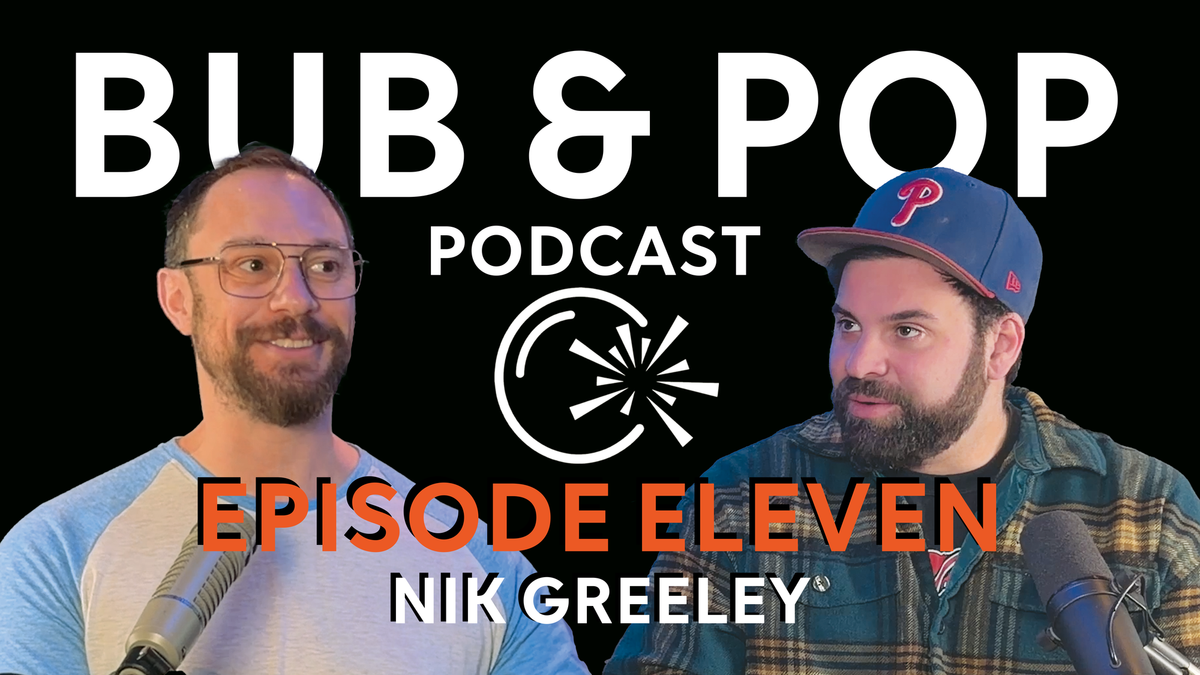
Bub & Pop | Episode 11: Nik Greeley (recorded February 3, 2026)
Nik Greeley has been a fixture of the Philly music scene for the better part of two decades — he's done it all: fronting a 10-piece band, booking talent, slinging drinks behind the bar at Johnny Brenda's, and everything in between. We get into his early days with Swift Technique (my cousin Andy was a founding member, so there was no shortage of stories), his more recent foray into acting — beginning with an Orange Is the New Black cameo a decade ago — and the case for treating a wedding gig as an honest living instead of a compromise.
We also cover the night Joe Walsh sat in with the War on Drugs at Johnny Brenda's — where Nik was tending bar at the time — why a script deserves the same respect as a song, and how he backed into DJing almost by accident.
An audio-first version of this podcast is available here.
Nik Greeley | Website | Instagram | Facebook | Bandcamp | SoundCloud | Spotify
Bub & Pop | Website | YouTube | Instagram | TikTok | Facebook | X | Threads | LinkedIn | Audio-first |Discord
Host: Matt Hoffman | Producer: Tedd Kanakaris | Location: The Boom Room
TRANSCRIPT (lightly QC'ed)
Matt Hoffman [00:00]
Hi, I'm Matt Hoffman, and this is the Bub & Pop podcast, where we talk about music, careers in music, life, the universe, and everything.
Matt Hoffman [00:20]
So what's the latest and greatest with you and the Operators?
Nik Greeley [00:24]
At the current moment, the Operators — it's been a band, or what I'd actually consider a collective, for ten years now. It's expanded into something I originally didn't envision, but it's morphed over time. I'd say it's not just an original band, but very much an events band — a band that can do multiple things. We've done everything from high-profile festivals to weddings to playing at the zoo.
I've done a lot of different gigs in the last ten years. Once I started doing more wedding stuff, it opened me up to a world I'd been resistant to for a long time. I was striving to be an original artist, and I felt like a lot of the wedding and event musicians were a bit jaded about being a musician, and I didn't want to be that way.
But as time went on and you become more of an adult, I started to appreciate those gigs more. So right now I'd say the Operators is a fully functioning events band. We have original music, but we've honed in on being very good at the wedding and private event.
Everything from your mother's 60th birthday to the 4th of July celebration in Narberth Park. Originally I was so against this stuff, but over time it's evolved into this. A lot of that has to do with the fact that we're an eight-piece band, and it's important to me that the guys make a solid living from what we do.
Especially now that I've gotten older, those gigs really make that possible. They also open up other opportunities — having money to film videos or go record, things that are expensive. So at this moment, that's where the Operators are. It's expanded into a 15-to-20-person network of people rotating and playing.
That's also something I didn't anticipate. But I learned a lot from being in another band long ago called Swift Technique that had a very similar approach — a huge network of people to draw from at any time, if so-and-so was away or got kicked out of the band. I learned a lot from that period.
And I met so many people then who eventually started playing with the Operators too. So it's really been an interesting ride the last ten years — navigating the music business as a performer, a talent buyer, a marketer, you name it. I've worn a lot of different hats the 12 or so years I've been doing it professionally.
Matt Hoffman [03:50]
To one comment you made about being initially resistant — I could project some reasons I might imagine. But I'm curious: why do you feel you were resistant to it in the beginning?
Nik Greeley [04:01]
Just the general notion that that stuff's corny — that anybody in a wedding band, doing bar mitzvahs and stuff like that, was considered a kind of cornball musician and not a true, authentic musician. And I was striving to be very much an original artist.
And I did it — I'm not sitting here saying I didn't do it; I'm still doing it. But I started to really appreciate that it's an honest living and it's work. I actually grew to love doing weddings. I fucking love hamming it up as an emcee and doing all the wedding stuff.
At first I was so resistant. It started in Swift Technique — I learned it there. We'd do a run of shows, Friday and Saturday of original shows, and maybe try to squeeze in at least one wedding as a way of making good money.
At first I was like, why are we doing this? I was such a pain in the ass about it, and I hated it. But as we started doing it and I started making actual money, I was like, oh, this isn't so bad. And that carried over into the Operators, which wasn't the intention at first.
When I started the Operators, the thought wasn't, hey, I'm going to do everything Swift Technique did. I was in singer-songwriter mode, going for a very different thing at first, and then it evolved back into a big, funky, fun band thing — which I'm glad it did.
And I'm glad I came back into weddings too, because I'm happy to be able to make a living now, comfortably doing what I'm doing. I'm certainly not rich by any means, but it took a long time to get into a stable state where I wasn't doing the starving-artist thing, which I was really striving to get the hell out of. I didn't want to be part of that whole notion that all artists are poor.
Matt Hoffman [06:18]
Sure. So what was it like — and just for background, for folks who don't know: my cousin Andy was one of the founders of Swift Technique, a founding player. I've probably seen them since their earliest pre–Swift Tech gigs, like him and Jake playing the backyard of a high school graduation party. But what was it like being among the first handful of real emcees and vocalists for the band?
Nik Greeley [06:51]
Oh, man. Shout out to Andy Bree — love you.
Before I joined Swift Technique, they were among my top three favorite bands in Philly at the time. When I first saw them, it was at the Blockley — I forget what year, but it was during the Blockley's heyday. They kind of had a residency then, and at that moment they were just an instrumental band, which I thought was super hip. I was very into that phase, when there was no vocalist. This was post Sean. I found out all the history later from Greg Rosen, also one of my best friends, who really brought me into the band. Later I learned a lot of the history from Greg and Andy on really long drives — they were telling me all the crazy stories from the early days.
Especially the Temple basement stuff. I always kid that Swift Technique should have a Behind the Music, because there's so much that has happened. Respectfully — I love everybody — but a lot of shit. Anybody who knows the history of the band knows there's been a lot of band members and people leaving, a lot of crazy shit.
Matt Hoffman [08:22]
We can compare notes offline.
Nik Greeley [08:25]
There's a lot of stuff. But yeah, I was a huge fan of the band. I was determined — in the band I was in at the time, called Black Stars, an alternative hard-rock-funk band — to play a show with them. It worked out that we ended up playing one of those residency shows with them, and that was a big deal for me, because I was super into them and just wanted to get on their radar.
Then years and years later, I befriended their manager at the time, Jake Weaver. This was when I was in between Black Stars, figuring out my next thing — I wanted to do a solo thing. And he was really adamant, similar to Greg, about me starting to sing with the band.
At the time there was other stuff going on. Chelsea was singing but left the band for a bit because of things that were going on, and I came into the fold and started singing with them. It was like a little mini dream come true, because I was now singing with my favorite band in the city.
I was doing the music I'd really wanted to do more of in the band I was in, but we couldn't, because we were more of a rock band and the guys I was playing with were more rock-oriented. Now I was playing with guys steeped in jazz and R&B and funk, really playing it authentically, with a horn section. I was like, wow, this is so freaking cool.
They were in a really interesting position then, kind of in flux because of things happening internally. But we hit the ground and started gigging, and that started the next era of the band. Chelsea eventually came back into the fold, and then we had the two vocals — the full lineup. I think we were ten people at that point, with horns. It was a huge operation, but also so many cooks in the kitchen, so many personalities, so many egos. But it was my first real professional experience in a band.
Nik Greeley [10:46]
All the first professional things I got to do as an artist and musician came from Swift Technique. I took all the things I thought were best about the band and carried them with me the rest of my performing career — and learned not to repeat the things that were tough about it too.
You learn so much being in a band with that many people. I'm very grateful for everything I got to do with Swift, and I wish we could have done more. The thing that bothers me now, looking back: if all of us had been more mature about certain things, I think Swift could have gone as far as any band in this area — playing nationally, being a touring band. But I always kid that it was the Almost Famous moment of my life. Right on the cusp.
Matt Hoffman [11:52]
That's right. I know they were on screen for a hot minute during an episode of Orange Is the New Black. Were you on stage for that?
Nik Greeley [11:59]
Of course. That actually came from — classic in life — my buddy Aaron, a casting director, who hit me up one day on a whim and mentioned he was working for a Netflix show, and the creator was looking for a fun funk band. He thought of our band and said we should submit, but gave me no other detail. I knew nothing other than, hey, we have a chance of maybe being on a Netflix show.
We submitted the music videos and stuff we had at the time, and he got back to us almost immediately: the creator loves the band and wants to know if you'd be available to be up in New York on these dates and do a recording session for the show. Still no detail about what it was. I was the middleman for all this, so I kept going back and forth to the band, and they kept being like, what is this thing?
Finally, when I told them it was for Orange Is the New Black — once I got the news to them, they were still in disbelief, because at that point it was the biggest show on Netflix. Everybody was talking about it, watching it, reading the books too. It was a perfect moment to seize. We had to keep it under wraps for a long time, because you have to sign an agreement not to tell anybody the premise or plot. It was such a cool experience.
Nik Greeley [13:43]
And it actually helped propel — years later — me being in SAG now, part of where I'm at as a performer and entertainer. I'm actually focusing more on the acting side of things this coming year. Still going to do music, but really focusing on acting and trying to encompass me as a performer, a musician, an entertainer, and lump it all into one.
I guess I'm trying to rebrand a little bit. I've been doing the music thing a very long time, and I'm looking to really hone in on that completely. That experience gave me the confidence, because I didn't know at the time — they gave me lines. It was one of those things where I didn't know if we were just going to be playing in the background as extras, but the director that day was like, hey, you're going to be the one who comes out and does the whole "We Are the Rootz" thing — because we're an all-white Roots cover band.
Nik Greeley [15:02]
I had to do that take about ten times, various different versions. It was so much fun. We had a great time that whole day. And then to see it later — I still have friends and family who randomly hit me up like, I just saw your scene. I get a kick out of that.
Recently I had a similar experience — I was on Abbott Elementary as a background actor and got some really good shots. So now I'm striving to see how far I can go with the acting thing, because it feels very fresh to me — similar to how I first felt getting involved in music 20-something years ago, learning about the Philly scene, who to reach out to, who to know. It feels exciting in that way. Not that music isn't still exciting, but doing it 20 years, I'm feeling the need to expand. Even being a bartender at Johnny Brenda's and being a DJ now — I'm just trying to expand myself more.
A lot of my friends who've been doing this as long as I have are a little hard on themselves about where they're at. I think that has to do with putting so many eggs in the basket of being a musician — being hard on themselves because maybe they haven't attained the level of fame they'd hoped for at this point. But I'm very into just being as creative as I can in my adult life. I've been fortunate — I feel like I've accomplished a lot of what I set out to do, and now I'm like, what else can I do that excites me? Performing is always going to excite me, but I want to do it whether that's on stage or on camera. I'm going to be 36 in April, and I want to do as much as I can before all this goes to hell.
Matt Hoffman [17:22]
Because it feels like every day we're getting closer and closer to hell, too.
Nik Greeley [17:27]
Which is a whole other thing that you're feeling — with your dad, you know. I can't imagine the talks you might be having right now. It's just so real right now. Sometimes I feel selfish about pursuing or thinking certain things are important. They're important to me, of course, but in the grand scheme of life, survival feels like the most important thing right now. Being there for your friends and community, being a loving, understanding person — that's never felt more fucking important than anything else. So I'm focusing on that too. I want to do all these things, but I also just want to be a good person and be there for my friends. It's a crazy time.
Matt Hoffman [18:28]
Yeah. A lot of the issues out there in the world seem so big and thorny and multifaceted, and sometimes the best way you can have an impact — or at least the maximum impact — is at the local level. Even for me, with my family, it's toeing the line between letting my kids be kids and enjoying the world as kids do, and also — yeah, there's some real shit going on. How do you have those conversations? I don't know how you have those conversations.
Nik Greeley [19:03]
I just spent a good amount of time being sick, and in my delirium I went down this terrible rabbit hole — reading all the documents that just got released from the Department of Justice, and other stuff going on, things like Catherine O'Hara passing away. You're just like, God, it's all so fucking much, man.
And I'm still suckered in, still dialed in. It's funny, because I spent a lot of time with my dad too, hanging out with my pops, and now my dad is so hooked into Reddit world. So I'm in one corner doing this, and usually my dad — who's very much about trying to stay away from that sector of the world — is on Reddit. We're all doing the same shit. And I'm like, how can we all get out of this? Where are we all going to collectively band together and say, hey, we're going to stop using this stuff. We're done playing the game.
Matt Hoffman [20:14]
It's such a fine line with Reddit, too. I remember earlier on in the ChatGPT days, there was this example a lot of people would cite — oh my God, ChatGPT said if you want to make pizza you should put Elmer's glue in it, because somebody said it on Reddit clearly as a joke, and ChatGPT couldn't get it. But at the same time, right, wrong, or indifferent, Reddit is some of the most human shit out there. Sometimes that human shit is just people fucking around.
You mentioned Catherine O'Hara — I heard Christopher Guest recently on one of the last episodes of Marc Maron's podcast, clearly saying some completely funny, made-up shit about Abraham Lincoln or something. But somebody could read that transcript and be like, oh wow, can you believe Abraham Lincoln wore boxers with hearts on them, or whatever nonsense. It's a strange world we live in. But it's interesting you mention Catherine O'Hara — because some people think Catherine O'Hara and it's Home Alone, some think Waiting for Guffman, or some of the Schitt's Creek.
Nik Greeley [21:39]
I mean, yeah — Schitt's Creek means Catherine O'Hara for so many people.
Matt Hoffman [21:45]
Exactly. So for you, as an actor, which is more appealing — the really scripted, come-in-and-say- your-line stuff, or making it up on the spot, having more flexibility?
Nik Greeley [21:58]
I think how I feel about the music I love is how I feel about acting too. It's a good blend of scripted and then finding those moments to have the improvisation and let that magic happen naturally. A good song is a good song, just like a good script is a good script. So for me there's a balance with improv. I'm surrounded by a lot of improvisational people, musically and acting-wise — very talented at improvising. But I'm a big fan of having the structure there, and then finding those moments and nuggets to know when you can insert the improvisation and have it feel exciting, and then come back to that structure and have it really come home.
I'm a firm believer that, similar to a great song, a great script deserves to be served. That's why so many writers and directors can be sticklers — even when actors try to improv, they'll say, stick to the fucking script. But someone like Catherine O'Hara just had a magic and a talent that I think even directors who stick to scripts would say, that was perfect. Certain people just have that ability. As I go on and start taking improv classes, I'm interested to see how much more I get into it. It can be scary — especially in acting, when a script can feel so safe, it can be very scary to break away from that. But that's where the magic happens.
Someone like John has made me realize that more and more — attending stuff like Dungeon Crawl. Admittedly, I go back and forth. I always joke how I'm like, I'm over the jam scene, I'm over this shit. But then I go to certain nights, like Dungeon Crawl, and you witness it in person. I think that's when it's most powerful for me. If I'm sitting at home listening to improvisation, it kind of goes over my head. But when I'm in person, focused on it, witnessing it in real time, I appreciate it more. And a lot of times we don't know when things are improvised acting-wise; we hear about it later. I was watching something on Scorsese the other night — Joe Pesci talking about how he improvised that whole "funny how" scene. You're thinking, holy fuck, that's one of the best scenes ever, and it came from a real-life experience, and it was all improvised. And to watch the reactions of those guys in the scene — Ray Liotta so masterfully taking it in, all the guys around him getting real grim — it's awesome.
So yes, I'm definitely a fan of structure, but I'm always trying to find ways in music and acting to be improvisational and have it feel like it almost is structured.
Matt Hoffman [25:38]
Well, yeah, it's risk-taking. And with any risk, it's ultimately about the unknown — and to your point, you don't know until after the fact how it went. There are so many examples of classic lines, whether it's Harrison Ford doing stuff in Indiana Jones and Star Wars, to Robin Williams improvising — oh my God.
Nik Greeley [25:59]
Robin Williams — also just, like —
Matt Hoffman [26:02]
Yeah, just out of control.
Nik Greeley [26:03]
The genie stuff. When you hear the unedited takes of that — I miss him. I miss Robin Williams.
Matt Hoffman [26:12]
You and me both, buddy.
Nik Greeley [26:13]
So yeah. Something that should always be remembered in the arts — music or acting — is that it's okay to fall on your face a little bit. It's okay to flub up or make a mistake. Those imperfect moments lead to you honing your craft more. Admittedly, this is something I'm still working on — I've talked about it in therapy — but I'm always afraid of making a mistake. It's the root of so many things in my life, that fear, and I'm always trying to get past it and be like, oh man, just fucking do it. Stop caring so much about what someone else might think — that can get in your head a lot.
Especially with acting, and guys first starting off — you're in a room with people who are more experienced, or you go to a jam session and you're around people who are more experienced, and it can feel so intimidating. But especially in the music world, I've always appreciated the guys who've seen that and come over and been good about it — like, hey, try this next time, or try listening for this, or try playing less. I think that's such a beautiful thing when someone's able to do that. And working in hospitality as long as I have, that's so appreciated too, because it can be very intimidating being around experienced bartenders or servers, feeling like, oh my God, I'm afraid to ask this question — and then someone comes over and eases that. It's the best feeling in the world.
So I'm trying to be that person now, in my veteran statesmanship, because — like I mentioned — I'm trying to rebrand a little bit. I want to be that guy who's a bit of a mentor for people coming up in the scene, who want to hear from a guy who's experienced not only in performing life but also the behind-the-scenes life — being a talent buyer, working in marketing, understanding things about the music business and entertainment that are helpful for navigating your career.
I also consider myself a bit of a Philadelphia music historian at this point. Before we started the interview, we were talking about bands from the last 20 or 25 years that really helped shape and mold everything that's still the Philly music scene. And this neighborhood, and the Boom Room — I've spent so much time in this area rehearsing, working on music, and hanging out, more than any other music space in Philly, I think I can honestly say. Besides when I was out in Ardmore, this place has been such a central hub to my creative life and so many other people's in the area.
Nik Greeley [29:12]
And Johnny Brenda's is now that for me as work. But even before I started working there, it was the place you wanted to go play, the place you wanted to go see people play. For a long time it was also very hard to get into to play, because the original talent buyers and bookers were very honed in on presenting Johnny Brenda's a certain way and only having certain acts. I really loved the allure of it. It can be very frustrating when you're young and so determined to play there — like, why can't I get into Johnny Brenda's? But they were really building that whole mythical thing about the room and what it meant to play there.
Now, being there, it's cool to see how much it's expanded. I'm glad it still maintains its booking allure and is still a very well-respected room, but it's opened up a lot more to different artists stylistically. It was very rooted in the indie-rock thing for a very long time, but I think it's great how many different artists and styles are in the room now compared to 10 or 15 years ago. No knock — it was just very centered in that for a long time.
Matt Hoffman [30:40]
Oh, absolutely.
Nik Greeley [30:41]
I saw so many amazing shows there early on, and now to be working there is fun. I love when people come in for the first time and they're looking around, wanting to know, and I get to sit there and be like, well, Johnny Brenda's has been around a long time. I enjoy it — people love hearing about it, and hearing about the different people who've played there. Recently, my girlfriend, who's a huge War on Drugs fan —
Matt Hoffman [31:10]
I was going to ask about Joe Walsh.
Nik Greeley [31:12]
Got to take her to the War on Drugs show. We were on the Thursday night before Joe came. While Joe was sound-checking on Friday and Saturday, I got to creep upstairs. I was already downstairs working, and I was just a fly on the wall. I wasn't trying to intrude on the vibe, but it was so fucking unreal that Joe Walsh was there. The bar is here, and I could hear his footsteps basically above me. As soon as I heard the guitar — the slide guitar — really going, I quietly crept around, went up the back way, and got to be a fly on the wall for their sound check.
As a music fan, you live for the moments when you get to hear other musicians talking about a song, talking through parts, mentioning little details. And that's exactly what I was witnessing. Joe was working his way through one of their original songs, talking about it, but also interjecting his humor, making them laugh — just hearing his voice, talking like this to them and saying shit.
Nik Greeley [32:31]
I'm still getting goosebumps now. It's unreal. And then when they started Rocky Mountain Way and In the City, she's like, whoa. I knew about it for the week leading up, and I was told, do not say anything — so I kept the secret. It was a really, really hard secret to keep. I couldn't help thinking the whole time how exciting it must have been for anybody in the crowd who had no idea he was coming — already super pumped about War on Drugs, and then, look out, we're bringing out Joe Walsh.
And then Saturday night, seeing Kurt Vile, Joe Walsh, and Adam all on stage playing guitar together — it's an unbelievable thing. For Johnny Brenda's and what that means, and for War on Drugs to still be doing the event there — they could take it to any one of these venues, and I think it's amazing they keep it at JB's, that they love what JB's means to them and have kept that history alive. Adam talks about it a lot, living around the corner. I just love that whole history here — thinking about their first show being there, with Kurt Vile still in the band — and it's similar to what a lot of us felt early on when we started playing around here: like anything can happen. We're just trying to play good music. Sure, it'd be great to do all these things, but we're just trying to find a great space to play in. It's so cool how that all happened. It's so rare, such a fucking amazing thing, and it inspired so many people to chase that same feeling.
Matt Hoffman [34:28]
Yeah, there's a book there for sure.
Nik Greeley [34:30]
Yeah. I hope one day there's a definitive story told about JB's specifically, and what it's really meant — because what's grown out of this neighborhood alone, from Johnny Brenda's, is a real testament to that, for better or worse. This neighborhood has morphed in such a wild way — just looking at Front Street alone. JB's was the seed that helped everything else grow around here.
Matt Hoffman [35:04]
You mentioned some of the different hats you've worn over the years — marketing, talent buyer, bartender. In terms of your experience, what do you feel are some of the really important lessons as an artist that you've taken away from being a worker in different parts of the business?
Nik Greeley [35:30]
The discipline of work itself. Honing in on your craft, treating everything professionally, and finding stability in your life through what you do. I love the saying — if you find something you love to do, you'll never work another day in your life. It's a beautiful phrase, and I love what I do, but it's still fucking work. At some point in my adult life I learned it didn't matter whether you were at literal work or at home or with friends — everything in life requires effort. No matter what it is, it's work. It takes effort to maintain a marriage. It takes effort to maintain friendships. It takes effort to get up every day and eat healthy and go to the gym. It takes effort not to lose your fucking mind in this crazy world. It's all work.
So that's what I've taken from everything I've done. I've prided myself on believing in work ethic — what you put into life is what you get out. You can talk till the cows come home about doing this and that, but if you don't actually do it, it doesn't matter. And you never know, through what experience — bartending, a DJ gig, an acting gig, a music gig — who you're going to meet. Because I've learned one thing in life: it's all about who you know. It really is. You have to have talent, you have to be what I consider a good person, have all these tools — but at the end of the day it's so much about who you know, the relationships you have, what you've put in, and longevity. Respectfully, because it's fucking hard, a lot of people throw in the towel after a while, or pivot to other things — and that's great.
Nik Greeley [37:44]
But I've always been a firm believer in continuing to work and put in effort at the things you're passionate about, because things will come back. Call it karma, call it whatever — some force in the universe, some energy — it comes back. I'm a huge believer in that, and I've witnessed it on both ends of the spectrum. Especially with karma: respect karma at all costs, because it will fuck your ass.
Nik Greeley [38:25]
Print that shit. Karma is so fucking real. It's a beautiful thing. But yes — that's what I've taken from being a bartender, from working the box office, from being a dishwasher to being a talent buyer.
Nik Greeley [38:47]
Your work ethic and discipline, and what you put into what you do, will propel you to places you maybe didn't think of before. And if you keep an open mind to all these different avenues, it can really lead you to places you never thought you'd go.
Matt Hoffman [39:07]
What's one of those places you found yourself recently that you just didn't see coming? A good one.
Nik Greeley [39:13]
DJing.
Matt Hoffman [39:14]
Mhm.
Nik Greeley [39:15]
Yeah. DJing was always something I thought — yeah, from being the guy who'd man the aux cord at a party, and friends would be like, dude, nice tunes, man, good mix. I'd be like, yeah, I could DJ one day. It actually came from a few opportunities doing Dungeon Crawl with John, and then getting to fool around with the mixers at JB's and the International — because I worked at the International down the street for a little bit too. I was just plugging in my laptop, messing around with the faders. And from going to school for audio engineering, I have a good understanding of how to mix, but I'd never used a Pioneer, never really got into DJing. But once I picked up the littlest bit of the tricks of the trade, I was like, oh, this is awesome. Then I just fell into it, and got lucky that the guy who books JB's started being like, do you want to do this, do you want to have gigs? And I was like, sure.
And then my friend Tessa, who books the DJs at North Pole, came to a Dungeon Crawl one night and was like, I didn't know you did that, it was really good — you want to do that at North Pole? And I was like, absolutely. And DJing has been another great source of income, honestly, that I've discovered now. My other buddy — who I think you should interview at some point — his name is Ian Gray. You might have heard of Ian. He's a — yeah.
Matt Hoffman [41:01]
Is he a horn player?
Nik Greeley [41:02]
Awesome. He's from Swift Technique and has now gone on to start his own group in Asbury Park called the Ocean Avenue Stompers. He's played with all of us in the Philly scene. I call him the mayor of Manasquan. He's a guy to know. He inspired me, because Ian started to DJ a lot around Asbury Park, Bradley Beach, that area, and soon New York. I'm like, wow, Ian's getting a lot of really cool gigs DJing. He's got a super-duper setup. I'm still rolling pretty bare-bones, still relying on house mixers to get by. But that's part of this whole thing I'm talking about — with DJing, and now acting, and even bartending. I didn't expect to fall in love with bartending. I came back to hospitality because things weren't working out in the talent-buyer Ardmore world the way I'd hoped financially, and I was like, I gotta make more dough. Bartending has afforded me a quality of life I really struggled to have throughout my 20s, and I fell in love with the act of bartending. Bartending is no different than being a frontman, or even a fucking actor sometimes. Sometimes you've got to do some acting behind the bar — especially with someone who's bending your ear and you're like, yeah, oh God, sure.
Matt Hoffman [42:27]
It's like, what — we need more ice.
[42:29] — unknown speaker
Oh, sorry. Yeah, you've got to figure out a way to get away —
Nik Greeley [42:31]
— from the conversation. But those things are good examples — I never expected to fall into them, and I'm glad I did. Now I'm like, what's next? Acting definitely feels like the thing I want to pursue for the foreseeable future, while keeping music and all the other things I love in the wheelhouse. I want to explore the idea of being an all-around dude. At the end of the day, I feel like that's what I want my legacy to be — a guy who really tried his hand at a lot of different things, was good at a lot of them, and was able to accomplish a lot because of it.
So far, so good. I'm really proud of everything I've been able to do musically, and so proud of the guys in my band. I've always believed the guys I play with are some of the best musicians in the world, capable of playing on any big stage or with any big artist. The talent around here just speaks for itself. The other night at the Grammys was an absolute example — seeing Zach and Ricky on stage with Lauryn Hill, such a huge win for them, and for everybody who's played together over the years, to know we're all capable of being on that stage. I'm so proud they were up there and did so well. They've both grown so much in the last few years. And I like to think that through being in bands like the Operators or Swift Technique, everyone was able to grow as musicians and professionals in ways that led them to do all the things they're doing now.
Matt Hoffman [44:27]
Yeah, absolutely.
Nik Greeley [44:29]
It's a very special thing that I'm very grateful for and very proud we've all been able to do.
Matt Hoffman [44:37]
Here, here. So if you were writing the script, what would be the next acting role for you? What would be really exciting?
Nik Greeley [44:44]
I want, as my first breakthrough role, a small comedic-relief role in a sitcom or something. I'd love to get my feet wet with something like that — kind of me playing myself, in a way, because I love comedy and being goofy. But I'd also love to be taken seriously as an actor. I'd love to do a role that challenges me to go outside my comfort zone. And obviously I'd love to play a musician or a bartender — it just seems right.
Matt Hoffman [45:27]
You do that every day.
Nik Greeley [45:28]
But anything along those lines, I'd be thrilled — as my first goal as an actor, to get a role with a consistent speaking part, however long that might take. Another thing that inspires me is the stories of guys like Morgan Freeman or Samuel L. Jackson, who didn't get started with their acting careers until well into their 40s, or late 30s. I wish more of my creative friends could feel that sometimes, when they feel in a rut — you can start something new tomorrow. That goes for musicians who feel in a rut with where they are in their band or their own artistry. There's nothing stopping you from starting fresh.
That's something really liberating when you can feel it — you don't need to be rooted in any one thing or feel identified in any one way. You can be anybody you want to be, as long as you're being true to yourself. I hope that brings peace of mind, because that's another thing I'm striving for a lot lately. I saw this clip the other day that really enlightened me: most of us look for happiness, but what we're really striving for is peace. And that's more and more what I'm looking for in my everyday life, especially in the tumultuous climate we're in — finding peace, in the smallest of places. Sometimes when I'm behind the bar, I feel a sense of calm and peace. And every time I step on stage, that is my place, my zone, and that is what keeps me coming back time and time again — even through the hardships of life and being an artist, and things that have happened to me over the last several years. Any time I step on stage, I'm fully in my element, where I'm supposed to be. I hope everyone in life has that lightbulb moment where they find that for themselves.
Nik Greeley [47:56]
Maybe that's the meaning of life — finding that thing that lets you feel that freedom. And performance is that for me, completely. It's the ultimate escape — the healthiest form of escape.
Matt Hoffman [48:11]
Absolutely. Here, here, buddy. Well, I appreciate you making time to talk. We have so many stones left unturned — I'd love to talk again at some point.
Nik Greeley [48:21]
We need to properly catch a show. And do the whole hang — have Coleman come, all the buds, everyone who's been on this show. We should eventually have a hang, and you should do some kind of wrap dinner at a bar. We could all go to Johnny Brenda's, wherever. Or coordinate catching a show together — that would be fun. Ted's got to be there. Gary's got to be there. I'd love to catch a show with you. Anytime you see anything at Johnny Brenda's you might dig, please feel free. Also, if you guys are doing one of these sessions — Monday, Tuesday, Wednesday — I'm at Johnny Brenda's till 6 p.m., so if you want to come grab lunch, I gotta hook it up.
Matt Hoffman [49:07]
Oh, I appreciate it.
Nik Greeley [49:09]
Thank you, guys, for taking the time.